
On-Demand Webinar

Closing the Loop on Security Gaps: Announcing the Anvilogic & SafeBreach Integration

Partnerships
Detection Strategies
Blueprints
July 30, 2026 9:00 AM
CST
Online
On-Demand Webinar

Closing the Loop on Security Gaps: Announcing the Anvilogic & SafeBreach Integration

Detection Strategies

We're thrilled to announce our newest strategic partnership and two-way integration between Anvilogic and SafeBreach! Together, SafeBreach and Anvilogic connect attack simulation, detection engineering, and continuous validation into a single closed-loop workflow.

The SafeBreach CTEM Platform reveals exactly where your production security controls fall short. The Anvilogic Agentic SecOps platform takes each of those findings and turns them into deployable, tuned detections. SafeBreach can then re-run the same real-world attacks to confirm the new detection actually fires, turning validation, remediation, and re-validation into one continuous loop instead of three disconnected projects, and empowering SOC teams to modernize toward a continuously validated, self-closing detection posture.

The constant struggle of closing security gaps

Security teams have gotten good at finding where they're exposed. Breach-and-attack-simulation and exposure-validation tools run thousands of real attack techniques against production controls and return a precise, continuously refreshed list of what got through. Visibility is no longer the hard part.

The hard part is what comes next. Turning each finding into a tested, tuned, deployed detection is still manual, headcount-bound work, and it can't keep pace with what these tools surface. That's the bottleneck, and it's why teams are turning to AI to close gaps as fast as they find them.

That gap is what Anvilogic and SafeBreach close together.

What the closed loop is made of

SafeBreach brings the SafeBreach CTEM Platform, the enterprise standard for Adversarial Exposure Validation (AEV). It continuously tests security controls from the attacker's perspective and shows, with evidence, exactly where they fail. It's powered by SafeBreach Helm, its AI infrastructure layer, and grounded in the SafeBreach Exposure Validation Platform, pairing continuous breach-and-attack simulation with attack-path validation. Its threat-research team maintains the Hacker's Playbook of 33,000+ attack methods, with behavioral techniques mapped to MITRE ATT&CK and coverage for emerging threats added within 24 hours.

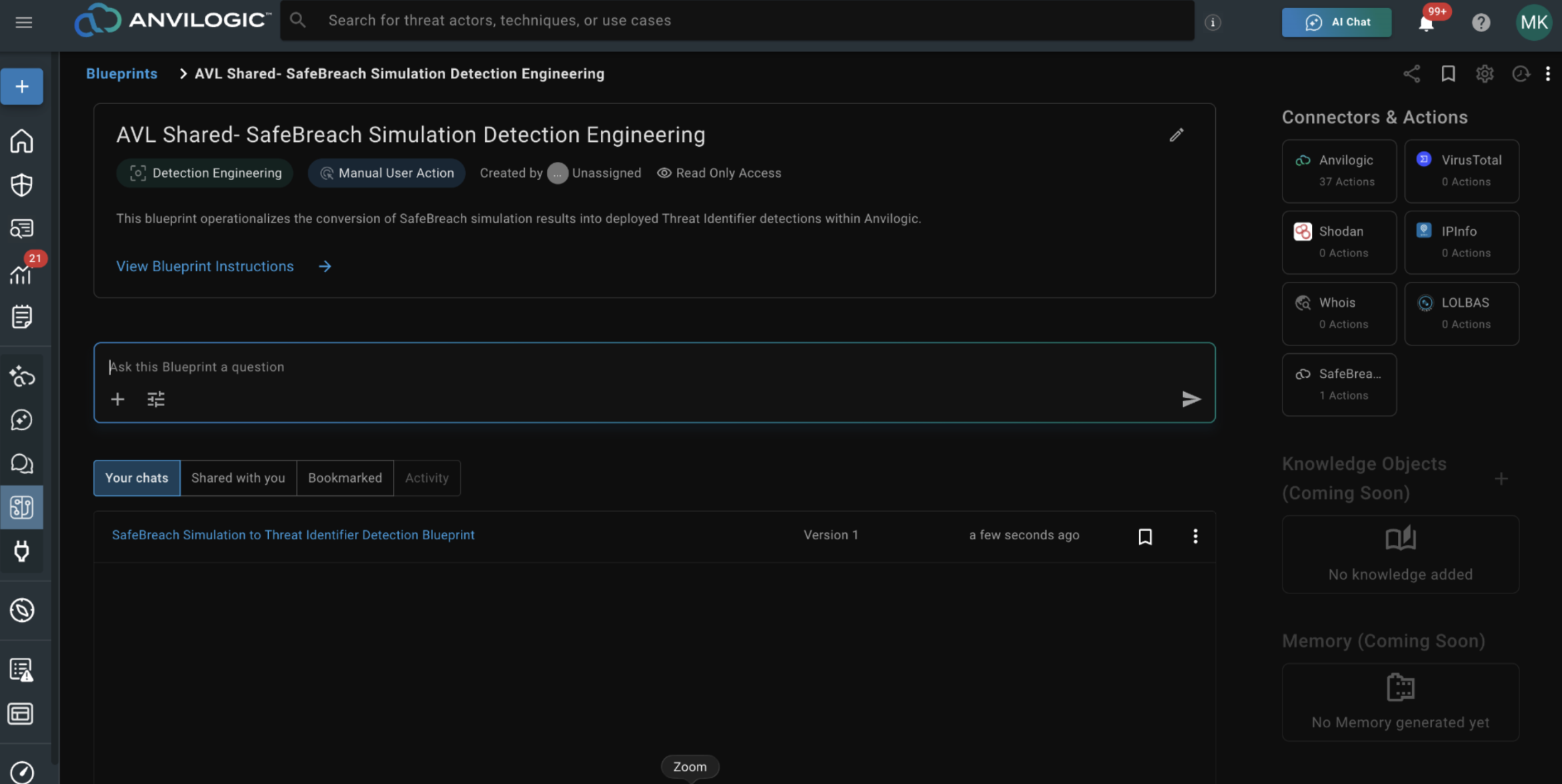
Anvilogic provides an agentic SecOps automation layer called "Blueprints" that SOC teams can leverage to build reusable, multi-step AI workspaces that capture a senior analyst's playbook and run it consistently across the team, with deterministic guardrails and human approval gates where they matter. In this case, Anvilogic's Continuous Detection Validation Blueprint can automatically convert a SafeBreach finding into a high-fidelity production detection across your SIEM, data lake, or a hybrid stack.
__wf_reserved_inherit

How the integration works

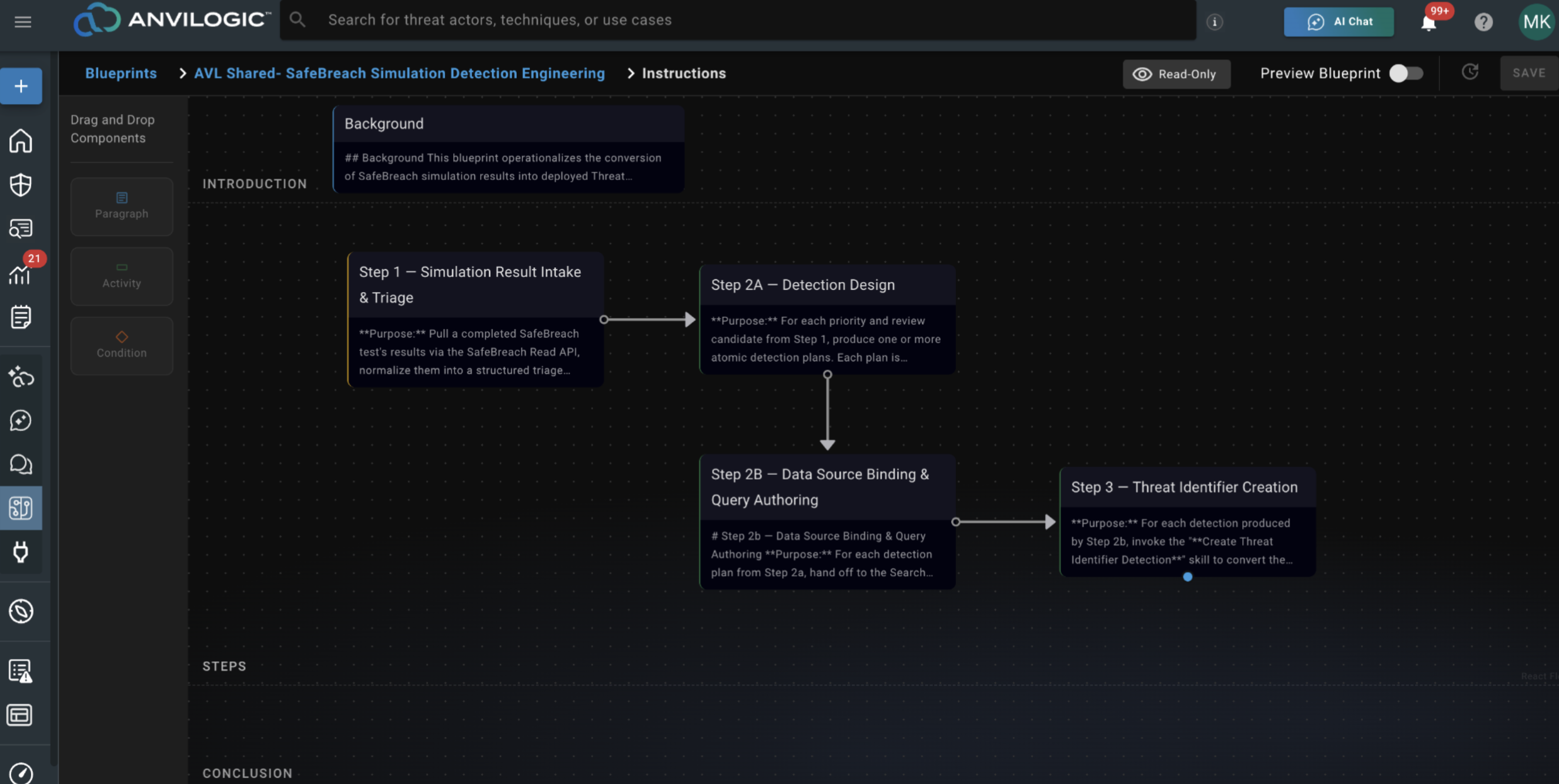
This is a two-way integration to create an effective security validation loop: findings flow from SafeBreach into Anvilogic, and detections flow back to SafeBreach for re-validation, all running on a daily cadence, and with human approval gates before anything reaches production.
__wf_reserved_inherit

1. Validate security gaps with SafeBreach

The SafeBreach CTEM Platform runs the attack scenarios relevant to your environment against your production controls, drawn from a library of 33,000+ real attack methods that span endpoint, email, network, web, cloud, and containers. Where an attack technique gets through, SafeBreach surfaces a validated, prioritized gap, mapped to MITRE ATT&CK. This isn't a theoretical coverage estimate; it's a control that demonstrably failed against a real technique.

2. Trigger Anvilogic's Detection Validation Blueprint, automatically

Each validated finding automatically triggers the Anvilogic Continuous Detection Validation Blueprint. No ticket routing, no manual export, no waiting for the next sprint. The same Blueprint can also be triggered by an analyst or other intel signals, so SafeBreach findings flow through the same remediation path as the rest of your detection pipeline.
__wf_reserved_inherit

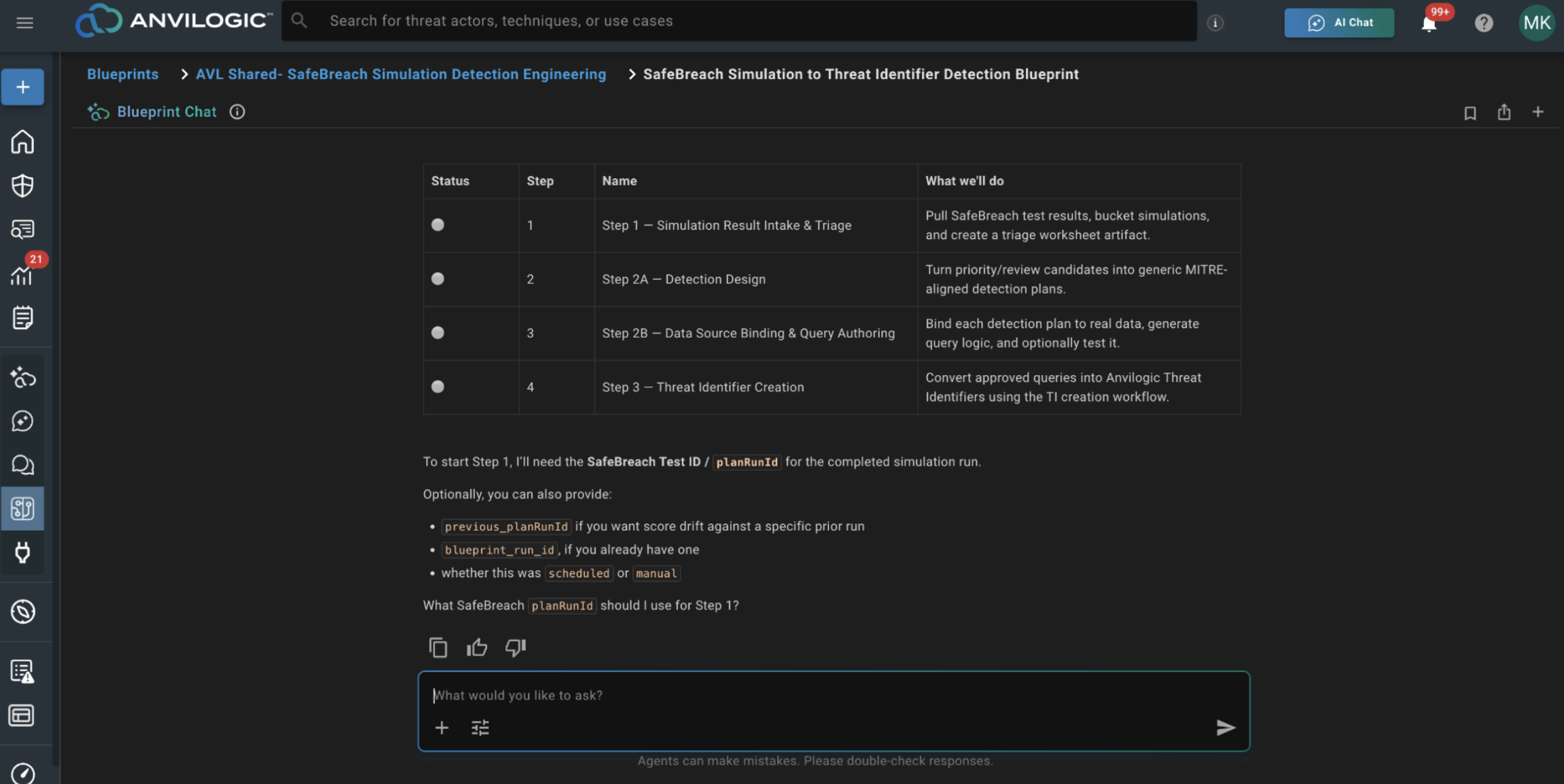
3. Anvilogic Blueprint reviews and confirms coverage

Before building anything, the Blueprint reviews the finding and checks which of your existing detections already fire on that technique. This prevents duplicate, redundant content and ensures the automation only does work where a real, uncovered gap remains. If you're already covered, the loop says so and moves on.

4. Create, test, and tune detections using Blueprints

Where a genuine gap exists, the Blueprint authors a new detection, tests it, and tunes it against your environment, reducing false positives before the detection ever reaches a human. Because Anvilogic is federated, the detection is built to run wherever your data lives: Splunk, Snowflake, a data lake, or a hybrid of all three. The output is mapped to MITRE ATT&CK so coverage stays legible on the same framework SafeBreach validated against.

5. Deploy Anvilogic's detections with human approval

The tuned detection is prepared for production behind a human approval gate. Nothing ships to prod without an explicit sign-off. The automation does the heavy, repetitive engineering work (discovery, authoring, testing, tuning), and the analyst keeps final say. That's the deliberate division of labor: machine speed on the toil, human control on the decision.

6. Re-validate and close the loop with SafeBreach

Once the detection is live, SafeBreach re-runs the same simulation to confirm the control now catches the attack. This is the step that turns the workflow from "we built something" into "we proved it works." Every cycle produces board-ready, audit-grade evidence that the identified gap is not only closed, but stays closed over time, and, just as importantly, that AI-generated detections fire against real techniques before you rely on them.

Who does what

- Role in the loop
SafeBreach: Proves what's exposed, and proves it's fixed
Anvilogic: Fixes what's exposed

- Core engine
SafeBreach: SafeBreach CTEM Platform, BAS plus attack-path validation, 33,000+ attack methods
Anvilogic: Blueprints, agentic automation on the federated SecOps platform

- Output
SafeBreach: Validated, prioritized control gaps mapped to MITRE ATT&CK
Anvilogic: Created, tested, tuned, deployed detections across SIEM and data lakes, mapped to MITRE

- Cadence
SafeBreach: Continuous, production-safe simulation
Anvilogic: Daily automated detection runs with human approval gates

- For the board
SafeBreach: Evidence trail that each validated gap is now covered
Anvilogic: Quantified security coverage

How it benefits your SOC team

The point of the loop isn't elegance, it's measurable outcomes. Here's what teams should expect to see.

  • Validated, not assumed. Coverage is proven against 33,000+ real-world attack methods, not asserted from a rule count. You can show the board the gap and the fix, side by side.
  • Closed, not queued. The loop runs daily and converts validated gaps into deployed detections, so the backlog flatlines, and then shrinks, cycle over cycle. MTTD on emerging threats drops because coverage lands close to when the gap is found, not a quarter later.
  • Scaled, not staffed. The remediation work that used to require additional detection engineers runs as a Blueprint. Coverage expands with the team you already have, with no new headcount and no rip-and-replace of your existing stack.
  • Verified, not hoped. As AI generates more of your detections, SafeBreach proves each one fires against real techniques before it's needed. "Trust, but verify."

The net effect: one unified workflow that accelerates detection maturity while measurably reducing risk. A BAS or exposure-program owner sees each simulation cycle become coverage in production instead of a ticket queue. And a CISO finally has a clean answer to the question the board keeps asking, "do our detections actually work?", backed by evidence on both the gap and the fix.

If this type of security is interesting to you, check out our podcast session on the SafeBreach Podcast, or register for our upcoming webinar!

Get the Latest Resources

Leave Your Data Where You Want: Detect Across Snowflake

Demo Series
Leave Your Data Where You Want: Detect Across Snowflake
Watch

MonteAI: Your Detection Engineering & Threat Hunting Co-Pilot

Demo Series
MonteAI: Your Detection Engineering & Threat Hunting Co-Pilot
Watch
White Paper

Closing the Loop on Security Gaps: Announcing the Anvilogic & SafeBreach Integration

Partnerships
Detection Strategies
Blueprints
July 30, 2026

Closing the Loop on Security Gaps: Announcing the Anvilogic & SafeBreach Integration

Partnerships
Detection Strategies
Blueprints
No items found.

We're thrilled to announce our newest strategic partnership and two-way integration between Anvilogic and SafeBreach! Together, SafeBreach and Anvilogic connect attack simulation, detection engineering, and continuous validation into a single closed-loop workflow.

The SafeBreach CTEM Platform reveals exactly where your production security controls fall short. The Anvilogic Agentic SecOps platform takes each of those findings and turns them into deployable, tuned detections. SafeBreach can then re-run the same real-world attacks to confirm the new detection actually fires, turning validation, remediation, and re-validation into one continuous loop instead of three disconnected projects, and empowering SOC teams to modernize toward a continuously validated, self-closing detection posture.

The constant struggle of closing security gaps

Security teams have gotten good at finding where they're exposed. Breach-and-attack-simulation and exposure-validation tools run thousands of real attack techniques against production controls and return a precise, continuously refreshed list of what got through. Visibility is no longer the hard part.

The hard part is what comes next. Turning each finding into a tested, tuned, deployed detection is still manual, headcount-bound work, and it can't keep pace with what these tools surface. That's the bottleneck, and it's why teams are turning to AI to close gaps as fast as they find them.

That gap is what Anvilogic and SafeBreach close together.

What the closed loop is made of

SafeBreach brings the SafeBreach CTEM Platform, the enterprise standard for Adversarial Exposure Validation (AEV). It continuously tests security controls from the attacker's perspective and shows, with evidence, exactly where they fail. It's powered by SafeBreach Helm, its AI infrastructure layer, and grounded in the SafeBreach Exposure Validation Platform, pairing continuous breach-and-attack simulation with attack-path validation. Its threat-research team maintains the Hacker's Playbook of 33,000+ attack methods, with behavioral techniques mapped to MITRE ATT&CK and coverage for emerging threats added within 24 hours.

Anvilogic provides an agentic SecOps automation layer called "Blueprints" that SOC teams can leverage to build reusable, multi-step AI workspaces that capture a senior analyst's playbook and run it consistently across the team, with deterministic guardrails and human approval gates where they matter. In this case, Anvilogic's Continuous Detection Validation Blueprint can automatically convert a SafeBreach finding into a high-fidelity production detection across your SIEM, data lake, or a hybrid stack.

__wf_reserved_inherit

How the integration works

This is a two-way integration to create an effective security validation loop: findings flow from SafeBreach into Anvilogic, and detections flow back to SafeBreach for re-validation, all running on a daily cadence, and with human approval gates before anything reaches production.

__wf_reserved_inherit

1. Validate security gaps with SafeBreach

The SafeBreach CTEM Platform runs the attack scenarios relevant to your environment against your production controls, drawn from a library of 33,000+ real attack methods that span endpoint, email, network, web, cloud, and containers. Where an attack technique gets through, SafeBreach surfaces a validated, prioritized gap, mapped to MITRE ATT&CK. This isn't a theoretical coverage estimate; it's a control that demonstrably failed against a real technique.

2. Trigger Anvilogic's Detection Validation Blueprint, automatically

Each validated finding automatically triggers the Anvilogic Continuous Detection Validation Blueprint. No ticket routing, no manual export, no waiting for the next sprint. The same Blueprint can also be triggered by an analyst or other intel signals, so SafeBreach findings flow through the same remediation path as the rest of your detection pipeline.

__wf_reserved_inherit

3. Anvilogic Blueprint reviews and confirms coverage

Before building anything, the Blueprint reviews the finding and checks which of your existing detections already fire on that technique. This prevents duplicate, redundant content and ensures the automation only does work where a real, uncovered gap remains. If you're already covered, the loop says so and moves on.

4. Create, test, and tune detections using Blueprints

Where a genuine gap exists, the Blueprint authors a new detection, tests it, and tunes it against your environment, reducing false positives before the detection ever reaches a human. Because Anvilogic is federated, the detection is built to run wherever your data lives: Splunk, Snowflake, a data lake, or a hybrid of all three. The output is mapped to MITRE ATT&CK so coverage stays legible on the same framework SafeBreach validated against.

5. Deploy Anvilogic's detections with human approval

The tuned detection is prepared for production behind a human approval gate. Nothing ships to prod without an explicit sign-off. The automation does the heavy, repetitive engineering work (discovery, authoring, testing, tuning), and the analyst keeps final say. That's the deliberate division of labor: machine speed on the toil, human control on the decision.

6. Re-validate and close the loop with SafeBreach

Once the detection is live, SafeBreach re-runs the same simulation to confirm the control now catches the attack. This is the step that turns the workflow from "we built something" into "we proved it works." Every cycle produces board-ready, audit-grade evidence that the identified gap is not only closed, but stays closed over time, and, just as importantly, that AI-generated detections fire against real techniques before you rely on them.

Who does what

- Role in the loop
SafeBreach: Proves what's exposed, and proves it's fixed
Anvilogic: Fixes what's exposed

- Core engine
SafeBreach: SafeBreach CTEM Platform, BAS plus attack-path validation, 33,000+ attack methods
Anvilogic: Blueprints, agentic automation on the federated SecOps platform

- Output
SafeBreach: Validated, prioritized control gaps mapped to MITRE ATT&CK
Anvilogic: Created, tested, tuned, deployed detections across SIEM and data lakes, mapped to MITRE

- Cadence
SafeBreach: Continuous, production-safe simulation
Anvilogic: Daily automated detection runs with human approval gates

- For the board
SafeBreach: Evidence trail that each validated gap is now covered
Anvilogic: Quantified security coverage

How it benefits your SOC team

The point of the loop isn't elegance, it's measurable outcomes. Here's what teams should expect to see.

  • Validated, not assumed. Coverage is proven against 33,000+ real-world attack methods, not asserted from a rule count. You can show the board the gap and the fix, side by side.
  • Closed, not queued. The loop runs daily and converts validated gaps into deployed detections, so the backlog flatlines, and then shrinks, cycle over cycle. MTTD on emerging threats drops because coverage lands close to when the gap is found, not a quarter later.
  • Scaled, not staffed. The remediation work that used to require additional detection engineers runs as a Blueprint. Coverage expands with the team you already have, with no new headcount and no rip-and-replace of your existing stack.
  • Verified, not hoped. As AI generates more of your detections, SafeBreach proves each one fires against real techniques before it's needed. "Trust, but verify."

The net effect: one unified workflow that accelerates detection maturity while measurably reducing risk. A BAS or exposure-program owner sees each simulation cycle become coverage in production instead of a ticket queue. And a CISO finally has a clean answer to the question the board keeps asking, "do our detections actually work?", backed by evidence on both the gap and the fix.

If this type of security is interesting to you, check out our podcast session on the SafeBreach Podcast, or register for our upcoming webinar!

Resources

Blog

SafeBreach Spotlights the Anvilogic Integration at Black Hat USA 2026 and DEF CON 34

SafeBreach's pre-show news roundup highlights the Anvilogic integration as one of three key stories on its newest AI capabilities ahead of Black Hat USA 2026 and DEF CON 34.

Anvilogic and SafeBreach Demo: Closed-Loop Detection Validation

A Blueprints demo showing how SafeBreach and Anvilogic connect attack simulation, detection engineering, and continuous validation into a single closed-loop workflow.

SafeBreach Podcast: Anvilogic on Going From Found to Fixed

Mackenzie Kyle joins the SafeBreach podcast to discuss how SOC teams can close the gap between finding security gaps and deploying detections that fix them.

See what Anvilogic can do for your SOC.

Talk to a practitioner who has been on your side of the problem.

July 30, 2026

Closing the Loop on Security Gaps: Announcing the Anvilogic & SafeBreach Integration

Partnerships
Detection Strategies
Blueprints

Resources

Blog

SafeBreach Spotlights the Anvilogic Integration at Black Hat USA 2026 and DEF CON 34

SafeBreach's pre-show news roundup highlights the Anvilogic integration as one of three key stories on its newest AI capabilities ahead of Black Hat USA 2026 and DEF CON 34.

Anvilogic and SafeBreach Demo: Closed-Loop Detection Validation

A Blueprints demo showing how SafeBreach and Anvilogic connect attack simulation, detection engineering, and continuous validation into a single closed-loop workflow.

SafeBreach Podcast: Anvilogic on Going From Found to Fixed

Mackenzie Kyle joins the SafeBreach podcast to discuss how SOC teams can close the gap between finding security gaps and deploying detections that fix them.

See what Anvilogic can do for your SOC.

Talk to a practitioner who has been on your side of the problem.

Product Vision
|
July 30, 2026
|
4 min read

Closing the Loop on Security Gaps: Announcing the Anvilogic & SafeBreach Integration

This is some text inside of a div block.

| Author

Anvilogic and SafeBreach connect attack simulation, detection engineering, and continuous validation into a single closed-loop workflow.

We're thrilled to announce our newest strategic partnership and two-way integration between Anvilogic and SafeBreach! Together, SafeBreach and Anvilogic connect attack simulation, detection engineering, and continuous validation into a single closed-loop workflow.

The SafeBreach CTEM Platform reveals exactly where your production security controls fall short. The Anvilogic Agentic SecOps platform takes each of those findings and turns them into deployable, tuned detections. SafeBreach can then re-run the same real-world attacks to confirm the new detection actually fires, turning validation, remediation, and re-validation into one continuous loop instead of three disconnected projects, and empowering SOC teams to modernize toward a continuously validated, self-closing detection posture.

The constant struggle of closing security gaps

Security teams have gotten good at finding where they're exposed. Breach-and-attack-simulation and exposure-validation tools run thousands of real attack techniques against production controls and return a precise, continuously refreshed list of what got through. Visibility is no longer the hard part.

The hard part is what comes next. Turning each finding into a tested, tuned, deployed detection is still manual, headcount-bound work, and it can't keep pace with what these tools surface. That's the bottleneck, and it's why teams are turning to AI to close gaps as fast as they find them.

That gap is what Anvilogic and SafeBreach close together.

What the closed loop is made of

SafeBreach brings the SafeBreach CTEM Platform, the enterprise standard for Adversarial Exposure Validation (AEV). It continuously tests security controls from the attacker's perspective and shows, with evidence, exactly where they fail. It's powered by SafeBreach Helm, its AI infrastructure layer, and grounded in the SafeBreach Exposure Validation Platform, pairing continuous breach-and-attack simulation with attack-path validation. Its threat-research team maintains the Hacker's Playbook of 33,000+ attack methods, with behavioral techniques mapped to MITRE ATT&CK and coverage for emerging threats added within 24 hours.

Anvilogic provides an agentic SecOps automation layer called "Blueprints" that SOC teams can leverage to build reusable, multi-step AI workspaces that capture a senior analyst's playbook and run it consistently across the team, with deterministic guardrails and human approval gates where they matter. In this case, Anvilogic's Continuous Detection Validation Blueprint can automatically convert a SafeBreach finding into a high-fidelity production detection across your SIEM, data lake, or a hybrid stack.

__wf_reserved_inherit

How the integration works

This is a two-way integration to create an effective security validation loop: findings flow from SafeBreach into Anvilogic, and detections flow back to SafeBreach for re-validation, all running on a daily cadence, and with human approval gates before anything reaches production.

__wf_reserved_inherit

1. Validate security gaps with SafeBreach

The SafeBreach CTEM Platform runs the attack scenarios relevant to your environment against your production controls, drawn from a library of 33,000+ real attack methods that span endpoint, email, network, web, cloud, and containers. Where an attack technique gets through, SafeBreach surfaces a validated, prioritized gap, mapped to MITRE ATT&CK. This isn't a theoretical coverage estimate; it's a control that demonstrably failed against a real technique.

2. Trigger Anvilogic's Detection Validation Blueprint, automatically

Each validated finding automatically triggers the Anvilogic Continuous Detection Validation Blueprint. No ticket routing, no manual export, no waiting for the next sprint. The same Blueprint can also be triggered by an analyst or other intel signals, so SafeBreach findings flow through the same remediation path as the rest of your detection pipeline.

__wf_reserved_inherit

3. Anvilogic Blueprint reviews and confirms coverage

Before building anything, the Blueprint reviews the finding and checks which of your existing detections already fire on that technique. This prevents duplicate, redundant content and ensures the automation only does work where a real, uncovered gap remains. If you're already covered, the loop says so and moves on.

4. Create, test, and tune detections using Blueprints

Where a genuine gap exists, the Blueprint authors a new detection, tests it, and tunes it against your environment, reducing false positives before the detection ever reaches a human. Because Anvilogic is federated, the detection is built to run wherever your data lives: Splunk, Snowflake, a data lake, or a hybrid of all three. The output is mapped to MITRE ATT&CK so coverage stays legible on the same framework SafeBreach validated against.

5. Deploy Anvilogic's detections with human approval

The tuned detection is prepared for production behind a human approval gate. Nothing ships to prod without an explicit sign-off. The automation does the heavy, repetitive engineering work (discovery, authoring, testing, tuning), and the analyst keeps final say. That's the deliberate division of labor: machine speed on the toil, human control on the decision.

6. Re-validate and close the loop with SafeBreach

Once the detection is live, SafeBreach re-runs the same simulation to confirm the control now catches the attack. This is the step that turns the workflow from "we built something" into "we proved it works." Every cycle produces board-ready, audit-grade evidence that the identified gap is not only closed, but stays closed over time, and, just as importantly, that AI-generated detections fire against real techniques before you rely on them.

Who does what

- Role in the loop
SafeBreach: Proves what's exposed, and proves it's fixed
Anvilogic: Fixes what's exposed

- Core engine
SafeBreach: SafeBreach CTEM Platform, BAS plus attack-path validation, 33,000+ attack methods
Anvilogic: Blueprints, agentic automation on the federated SecOps platform

- Output
SafeBreach: Validated, prioritized control gaps mapped to MITRE ATT&CK
Anvilogic: Created, tested, tuned, deployed detections across SIEM and data lakes, mapped to MITRE

- Cadence
SafeBreach: Continuous, production-safe simulation
Anvilogic: Daily automated detection runs with human approval gates

- For the board
SafeBreach: Evidence trail that each validated gap is now covered
Anvilogic: Quantified security coverage

How it benefits your SOC team

The point of the loop isn't elegance, it's measurable outcomes. Here's what teams should expect to see.

  • Validated, not assumed. Coverage is proven against 33,000+ real-world attack methods, not asserted from a rule count. You can show the board the gap and the fix, side by side.
  • Closed, not queued. The loop runs daily and converts validated gaps into deployed detections, so the backlog flatlines, and then shrinks, cycle over cycle. MTTD on emerging threats drops because coverage lands close to when the gap is found, not a quarter later.
  • Scaled, not staffed. The remediation work that used to require additional detection engineers runs as a Blueprint. Coverage expands with the team you already have, with no new headcount and no rip-and-replace of your existing stack.
  • Verified, not hoped. As AI generates more of your detections, SafeBreach proves each one fires against real techniques before it's needed. "Trust, but verify."

The net effect: one unified workflow that accelerates detection maturity while measurably reducing risk. A BAS or exposure-program owner sees each simulation cycle become coverage in production instead of a ticket queue. And a CISO finally has a clean answer to the question the board keeps asking, "do our detections actually work?", backed by evidence on both the gap and the fix.

If this type of security is interesting to you, check out our podcast session on the SafeBreach Podcast, or register for our upcoming webinar!

Resources

Blog

SafeBreach Spotlights the Anvilogic Integration at Black Hat USA 2026 and DEF CON 34

SafeBreach's pre-show news roundup highlights the Anvilogic integration as one of three key stories on its newest AI capabilities ahead of Black Hat USA 2026 and DEF CON 34.

Anvilogic and SafeBreach Demo: Closed-Loop Detection Validation

A Blueprints demo showing how SafeBreach and Anvilogic connect attack simulation, detection engineering, and continuous validation into a single closed-loop workflow.

SafeBreach Podcast: Anvilogic on Going From Found to Fixed

Mackenzie Kyle joins the SafeBreach podcast to discuss how SOC teams can close the gap between finding security gaps and deploying detections that fix them.