
.svg)


Security teams are already building their own AI agents. Alert triage is often the first use case: send an alert to Claude, ChatGPT, or another large language model (LLM) and ask it to summarize what happened, assess its severity, and recommend what an analyst should do next. The initial result can be impressive. It’s fast, understandable, and usually good enough to prove that AI can remove work from the queue.
But that prototype only proves a model can reason over the information it received. It doesn’t prove that the agent understands why the alert fired, knows what’s normal in your environment, or can improve the systems that created the alert. That’s where the build-versus-buy debate really begins.
The question isn’t whether your team can build an AI agent. It’s whether your team wants to own everything required to keep a growing collection of agents accurate, secure, and running in production.
What a successful prototype doesn’t prove
A general-purpose LLM doesn’t automatically understand the security environment surrounding an alert. It only knows what your team has connected and provided to it.
That may not include:
- The detection logic that caused the alert to fire
- How the detection has been tuned over time
- The data sources available to investigate it
- Missing telemetry that could change the conclusion
- Related alerts and previous investigations
- Earlier decisions made by your analysts
- Your organization’s thresholds, exceptions, and procedures
Without that context, the model can still produce a polished summary. But a polished summary isn’t the same as a reliable security decision.
Anthropic describes this problem in its explanation of the Model Context Protocol: even sophisticated models are limited when they’re isolated from the systems and data required to do the work. Connecting each new source through a custom implementation is also difficult to scale. For a SOC, that means passing an alert payload to an LLM is just the beginning. The agent also needs a reliable way to retrieve the context surrounding that alert.
Production agents need security context, not just alert data
A useful security agent needs to understand how the pieces of the environment relate to one another. That includes the alert, the detection that generated it, the available telemetry, previous tuning decisions, related activity, and the history of how analysts handled similar cases. For example, think about a privileged-login alert: the same activity could be expected for an administrator performing scheduled maintenance, suspicious for a standard employee, or critical if it involves a sensitive system and an unfamiliar location. The alert text alone may not reveal those differences. The agent has to inspect the surrounding environment before it can reach a defensible conclusion.
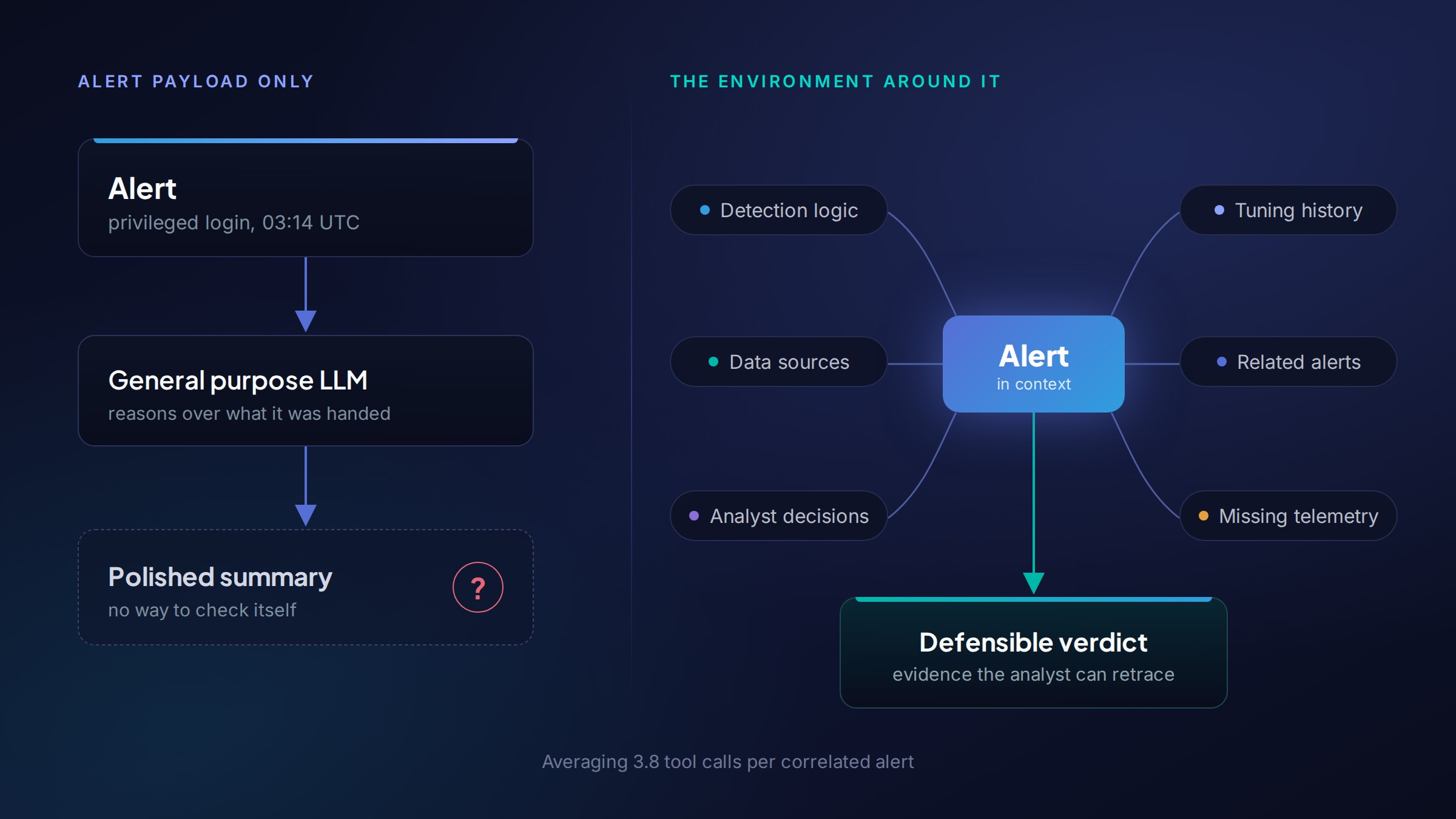
Anvilogic’s enterprise security graph provides that context. It connects detections, alerts, data sources, tuning history, evidence, and analyst activity so agents can investigate the environment rather than reason from a single prompt. Over the last three months, agents in Anvilogic customer environments made more than one million tool calls. Each call is an individual lookup or action used to gather evidence and complete a step in the agent’s reasoning. The alert analyzer averages 3.8 tool calls per correlated alert, so a verdict is assembled from repeated trips into the environment, not produced in one pass.
Triage should improve what happens before the next alert
Most DIY triage agents are designed to answer a downstream question: Is this alert malicious, benign, or worth escalating? That can help reduce the queue, but it doesn’t address why the work keeps appearing. If a recurring alert is a false positive, the detection may need to be tuned. If the agent can’t reach a conclusion because evidence is missing, the organization may have a telemetry or coverage gap. If an investigation uncovers a new technique, the team may need to create a new detection. Those outcomes shouldn’t disappear into a ticket or chat transcript. They should improve what happens before the next alert fires.
Anvilogic connects onboarding, search, detection, and investigation within the same operating loop. An investigation that stalls for missing evidence points at a data source to onboard. A recurring false positive points at a detection to tune. A new technique points at a detection to build. Investigation results can inform detection tuning, validation, coverage decisions, and the data the team collects next, so instead of only processing alerts faster, teams address recurring problems closer to their source.
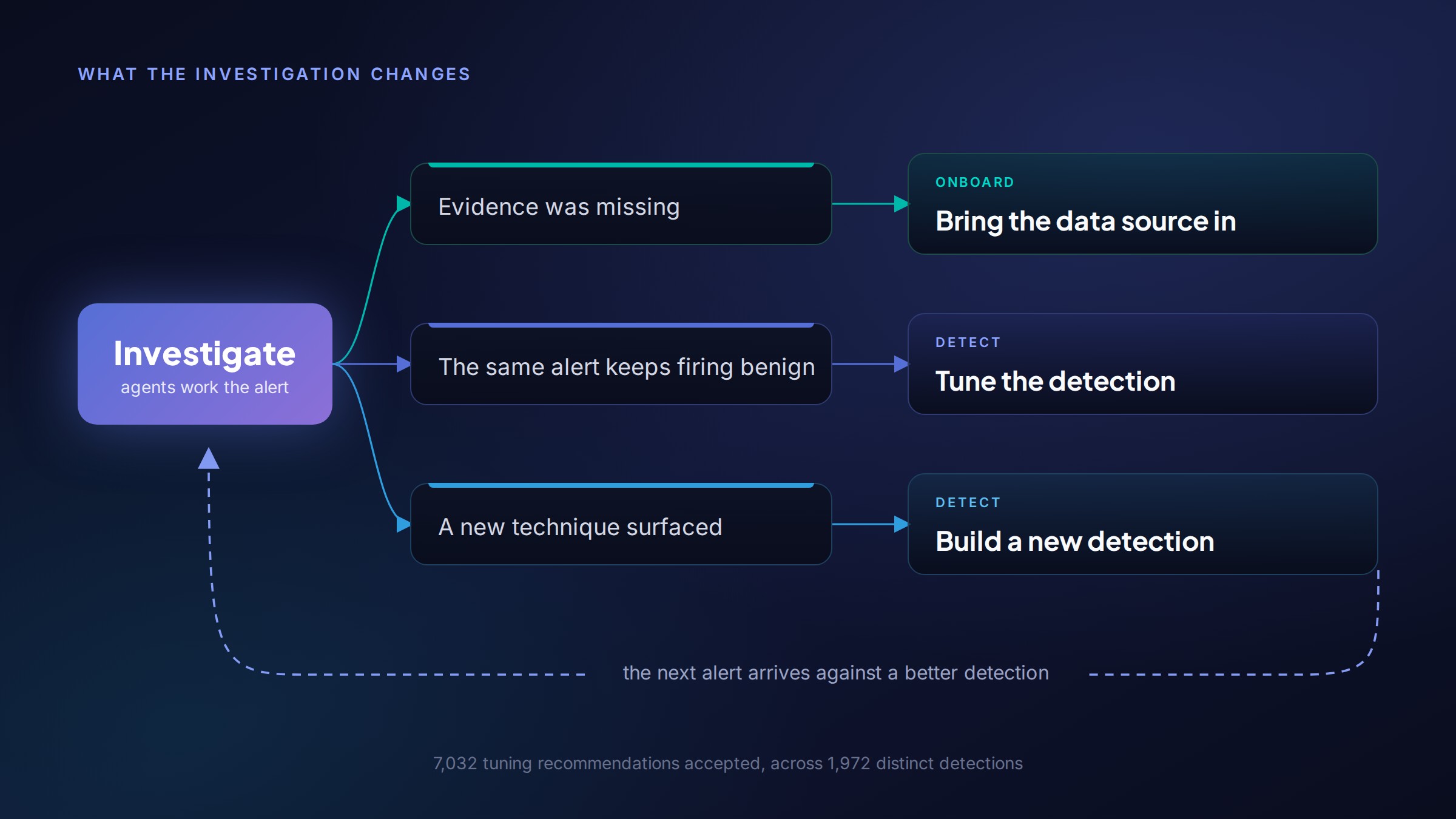
Over the last year, Anvilogic customers accepted 7,032 tuning recommendations, changing 1,972 distinct detections. Each accepted recommendation represents an investigation outcome being used to improve the detection that created the work.
The first successful agent creates the next problem
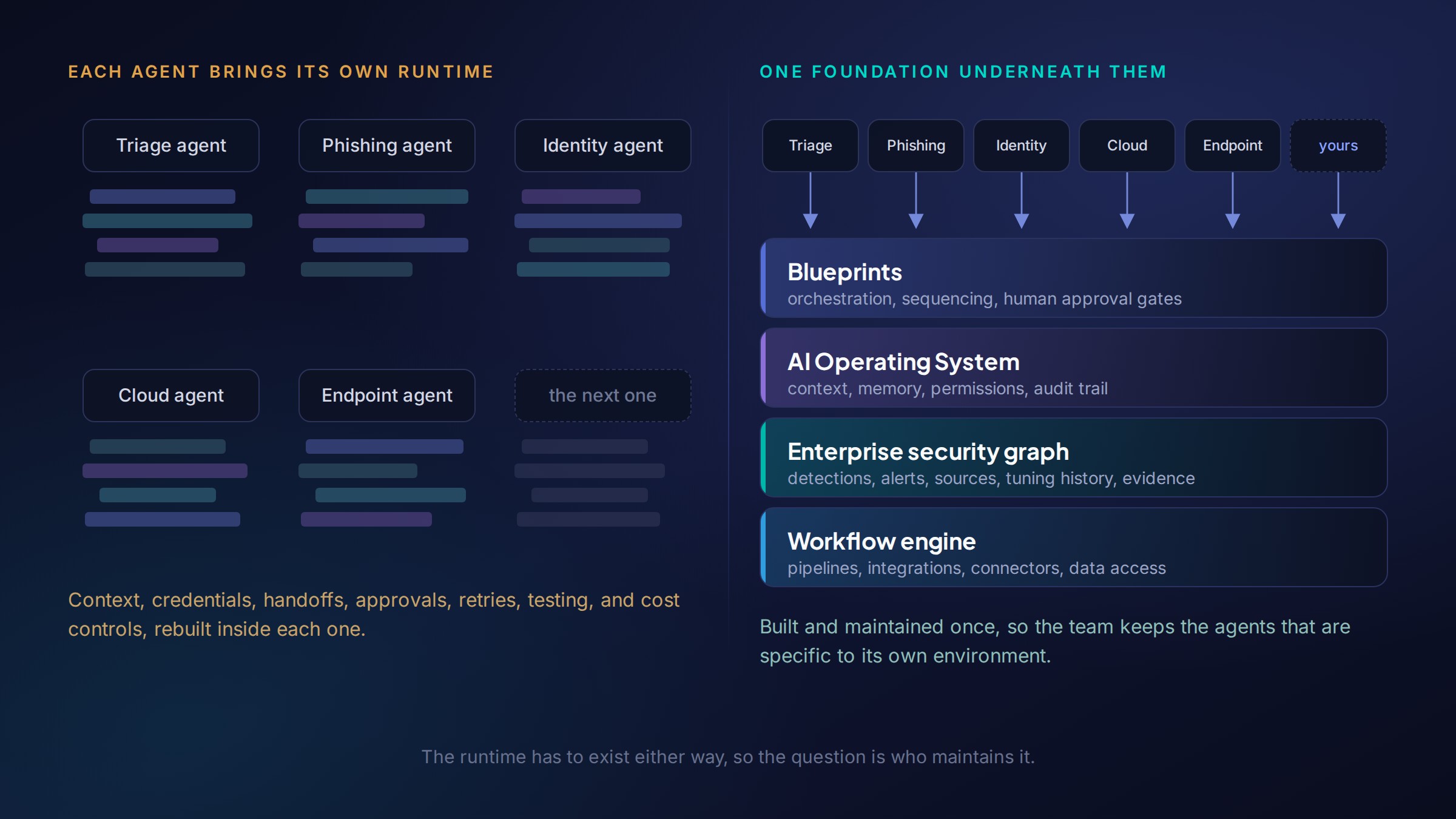
The biggest risk isn’t that the first agent fails, but that it works. Once a triage prototype shows value, other teams start building agents for phishing, identity investigations, endpoint alerts, cloud activity, threat intelligence, and other time-consuming workflows. Before long, the SOC has a collection of agents created by different people who use different prompts, models, permissions, connections, and assumptions. Several may perform overlapping work, ownership becomes unclear, and the person who built an agent may have moved to another priority.
Someone still has to manage:
- Context, memory, and state
- Credentials, permissions, and tool access
- Agent-to-agent handoffs
- Workflow sequencing and orchestration
- Human approval gates
- Evidence capture and audit trails
- Testing after models, prompts, APIs, schemas, detections, or feeds change
- Failures, retries, and concurrent execution
- Cost controls and usage limits
- Versioning, monitoring, ownership, and retirement
These aren’t edge cases; they’re part of operating agents in production. Microsoft recommends centralized governance for enterprise agents, including consistent identity, ownership, access controls, and continuous monitoring. Google Cloud calls for managed runtimes and built-in observability, while its guidance on continuous evaluation recommends monitoring agents for quality drift in production. AWS also warns that autonomous agents introduce failure modes that conventional resilience practices may not address. The hard part isn’t getting an agent to work once. It’s keeping every agent working safely and consistently as the security environment changes.
Operating agents becomes a permanent engineering responsibility
Security teams have analysts, detection specialists, and engineers who are capable of building useful agents. Technical ability isn’t the issue; it’s whether maintaining an internal agent platform is the best use of a limited team. Building an agent is a project, but operating the production foundation beneath a growing collection of agents is an ongoing engineering function.
That work competes with detection coverage, threat hunting, investigation, data onboarding, and the other responsibilities the security organization performs. Every quarter spent building and stabilizing an internal runtime is another quarter the team may still be manually doing work it intended to automate. This doesn’t mean security teams shouldn’t build anything themselves. It means they should be deliberate about which parts of the stack actually differentiate their operation.
Buying a foundation doesn’t mean abandoning what you built
Teams that have already created a useful triage agent, prompt library, or internal workflow shouldn’t have to start over. Existing agents can connect to Anvilogic through the Anvilogic MCP Server and use the platform’s security context, tools, and data access. This gives teams a middle ground between discarding their work and taking responsibility for an entire production platform. The team can keep the agents and workflows that are specific to its organization, while Anvilogic provides the enterprise security graph, orchestration, governance, data access, and maintained operating foundation beneath them.
Customer traffic through the Anvilogic MCP Server started in August 2026. In just the first 10 days, customer environments ran more than 1,700 agent calls through it. These are early numbers, but they demonstrate a practical path for connecting what teams have already built to a managed security platform.
When building an agent still makes sense
A DIY approach can be appropriate when:
- The use case is narrow and experimental
- Execution volume is limited
- A person reviews every result
- The agent has restricted access
- The consequences of an incorrect response are manageable
- The team is building to learn or validate an idea
The decision changes when agents start operating repeatedly across production security data, retrieving information from multiple systems, handing work to other agents, or taking actions that need to be controlled and audited. At that point, the organization isn’t only building an agent, but building an operating environment for agents.
What a maintained foundation makes possible
At a regional energy provider, Anvilogic helped a small security team expand its operational capacity without adding headcount. Based on seven months of product data, their:
- MITRE ATT&CK coverage increased from 46% to 83%
- Deployed detections increased from 28 to approximately 2,800
- Monthly events of interest increased from 2.4 million to 103.6 million
- Number of active users increased from five to seven
The team expanded its coverage, detection volume, and ability to work across a much larger volume of security activity. It didn’t have to build and maintain the agent infrastructure required to support that scale on its own.
Questions to ask before deciding to build
Security leaders shouldn’t compare the cost of an Agentic SecOps Platform with the price of an LLM subscription. Those represent very different operating models. Before deciding to build, ask:
- What security context will every agent be able to access?
- How will investigation outcomes improve detections and future workflows?
- Who will maintain each agent after its original builder moves to another priority?
- How will permissions, credentials, and data access be controlled?
- How will agents be tested after a model, prompt, API, schema, or detection changes?
- How will failures, retries, costs, and partial executions be managed?
- Where will human approval be required?
- How will every action be explained and audited?
- Can the agents and workflows already built connect to a maintained platform?
Your team should be able to build the agents and workflows that make your SOC unique. It shouldn’t have to build an entire production platform around them.
Build what makes your SOC different, buy the foundation required to run it.
See how Anvilogic gives security teams the context, orchestration, and governance required to run AI agents across security operations without creating another platform to maintain. Schedule a demo here.