
On-Demand Webinar

AI Agents Need More Than Just Data, They Need the Context of Your SOC.

Agentic SecOps
September 29, 2026 9:00 AM
CST
Online
On-Demand Webinar

AI Agents Need More Than Just Data, They Need the Context of Your SOC.

Detection Strategies

A generic AI agent starts every task from zero. It doesn’t know what data your organization has, where that data lives, which detections are deployed, what your team’s already tuned, how similar alerts were handled last quarter, or why an analyst made a particular call. You can give it a prompt and a set of integrations, but it’ll still begin each task by reconstructing context your platform already holds.

That’s a problem that’s especially acute in security operations because a SOC isn’t a collection of isolated tasks. Every decision depends on what came before it. An alert only means something when you understand the detection that produced it, the tuning applied to that detection, the quality of the feed underneath it, and what happened the last five times something similar fired.

Agents are getting easier to build, but giving them enough context to make decisions that actually reflect the environment they’re operating in is much harder. Anvilogic’s Enterprise Security Graph is built to solve that.

Your SOC already knows more than your AI does

Every day, security teams make thousands of decisions that shape how the SOC operates. A new feed gets onboarded, a detection gets deployed, an alert fires, an analyst determines it’s benign, a noisy condition gets allowlisted, or a case is closed as authorized activity. That history is the most accurate description of how your organization actually operates, but it’s scattered across product areas, workflows, and the heads of individual analysts. Even when the information exists, an agent starting a new task has to go find it again.

Anvilogic’s Enterprise Security Graph connects that accumulated operational history so agents and workflows begin with an understanding of the environment, its priorities, its history, and the reasoning behind past decisions.

Where the graph sits in Anvilogic’s AI Operating System

Anvilogic’s Agentic SecOps platform runs on four layers, and it’s worth understanding how they fit together, because the Enterprise Security Graph isn’t a standalone product. At the bottom is the Workflow Engine, the non-AI foundation that handles pipelines, integrations, and connectors, and it’s what actually moves and shapes the data. Above that are the AI agents, task-scoped workers that onboard a feed, write a search, build a detection, or triage an alert. Coordinating those agents is the AI Operating System, which decides which agent runs when, manages the context each one receives, and enforces the approval gates you’ve configured. And at the top are Blueprints, the orchestration layer that chains agents together into repeatable workflows your team can run the same way every time.

The Enterprise Security Graph is the context layer of that operating system. Agents are the workers and Blueprints are the workflows, but the graph is what either of them knows before they start. Without it, the AI OS can still route work to the right agent at the right time; it just routes an agent that’s starting from zero. With it, every agent and every Blueprint step runs on top of the same understanding of your environment, your priorities, your history, and your prior decisions, and everything they produce flows back into it.
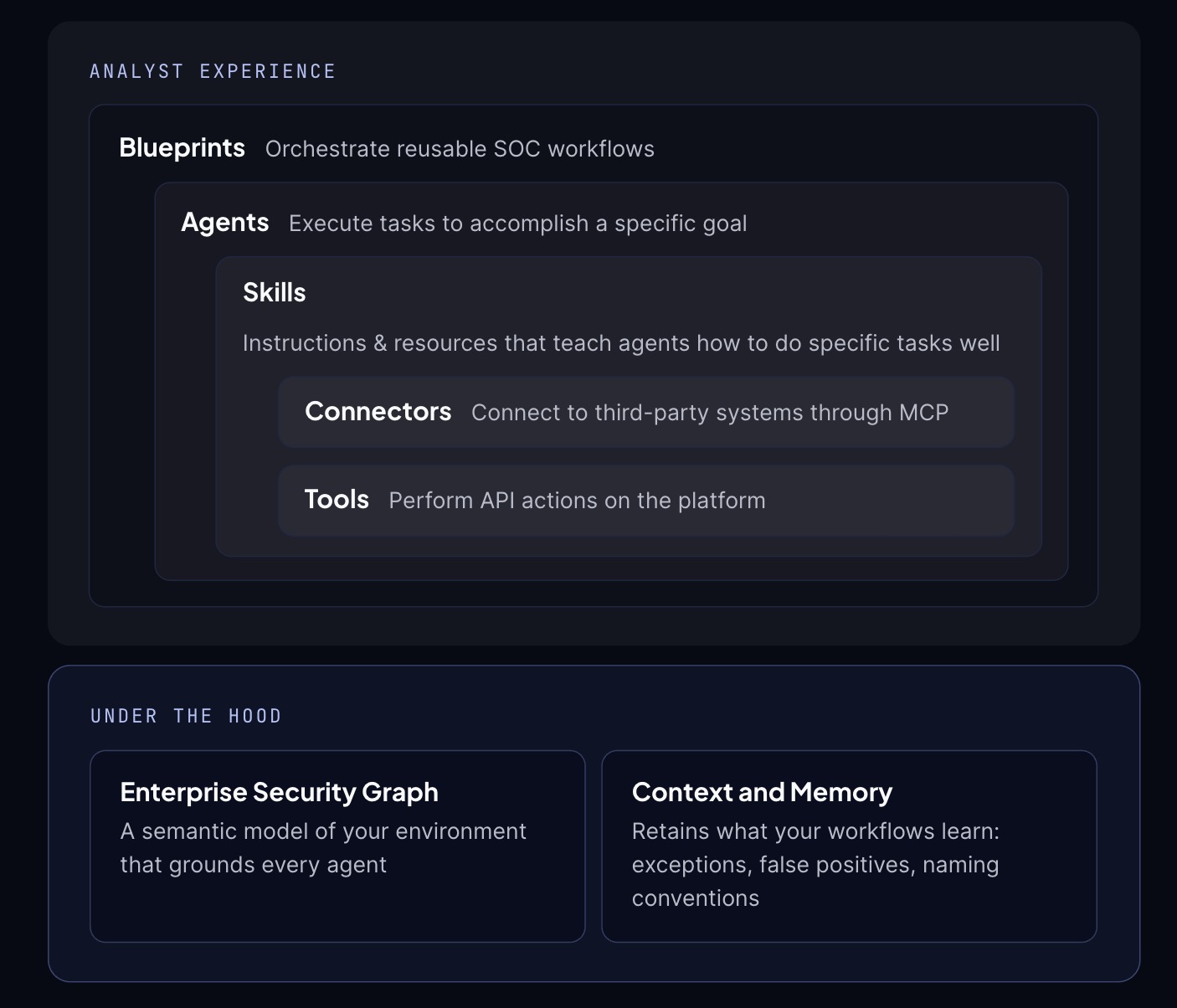
Diagram of the Anvilogic AI Operating System layers, with Blueprints, agents, skills, connectors and tools in the analyst experience and the Enterprise Security Graph and context and memory under the hood
The Enterprise Security Graph is the context layer of the AI Operating System, so every agent and every Blueprint step runs on the same understanding of the environment, and everything they produce flows back into it.

Context isn’t more data, it’s the connections

Giving an agent access to more records doesn’t make it smarter. What matters is how those records relate to one another. Take a single alert. To investigate it well, an agent needs to know which detection generated it and which data feed that detection depends on. It needs to know whether the feed is healthy and trustworthy, what tuning has already been applied and why, how previous alerts from the same detection were resolved, and whether the same user, host, or indicator appeared in another case. That’s not one lookup. It’s a connected chain.

As a single thought, that chain might look like this: this alert came from this detection, which reads this feed, which carries a poor quality label and an open health failure, and the same host appeared in a case two weeks ago. No single product area holds that sentence, but the Enterprise Security Graph does, because Anvilogic links feeds to schemas, detections to the data they read, alerts to the detections that generated them, tuning decisions to their reasons, and cases to the entities, indicators, and outcomes involved.
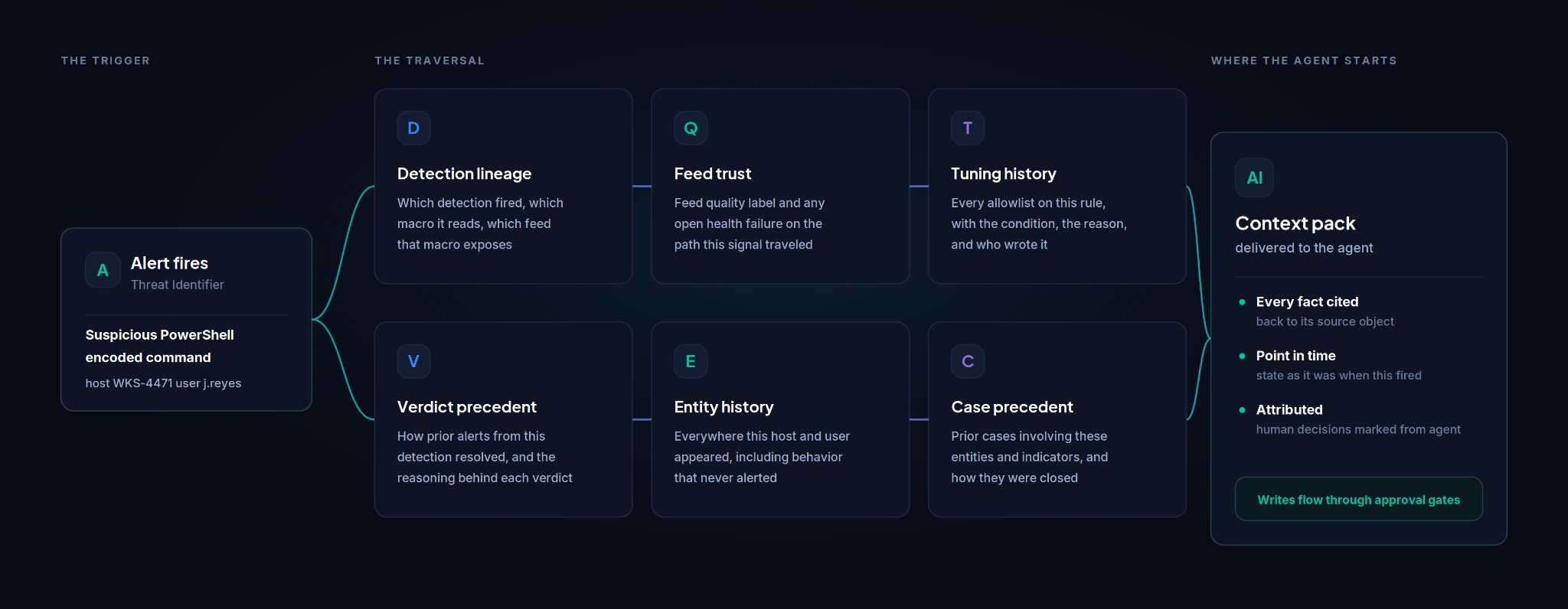
Diagram of a single alert traversing the Enterprise Security Graph across detection lineage, feed trust, tuning history, verdict precedent, entity history and case precedent into a cited context pack
Before an agent starts, the Enterprise Security Graph pulls the detection lineage, feed trust, tuning history, verdict precedent, entity history, and case precedent behind a single alert.

The decisions matter as much as the alerts

Most security systems are good at recording what happened: a detection fired, an alert was created, a rule changed, or a case was closed. The more useful context, usually, is why. Why was this alert closed as benign? Why was this user allowlisted? Why did an analyst decline a tuning recommendation? Why was one event escalated, while an almost identical one wasn’t?

Those decisions encode the judgment of your SOC, which is why the Enterprise Security Graph treats them as content rather than exhaust. Verdicts, tuning accept and decline records, allowlist reasons, case closure codes, and Blueprint session justifications retain their full rationale, who made the decision, whether it was a human or an agent, and when it happened. Over time, agents can operate with precedent. Instead of only asking, “What does this alert look like?” they can also ask, “How has this organization handled situations like this before?”
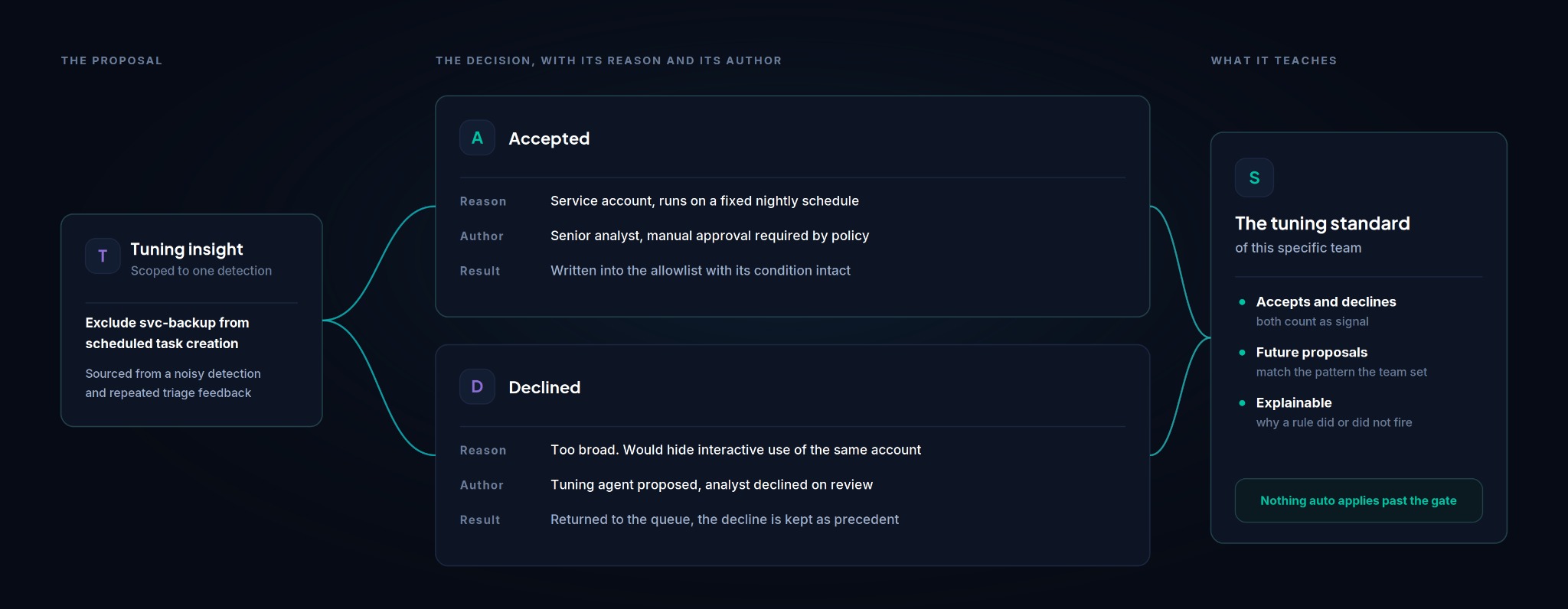
Diagram of a tuning insight that is accepted or declined, each outcome carrying its reason and author, and both becoming the tuning standard for the team
Every tuning decision carries its reason and its author, so accepts and declines both become precedent for how this team tunes.

Context should improve every time the SOC works

The Enterprise Security Graph brings together context from across the full security operations lifecycle, not just the alert queue, so onboarding knows what feeds exist and what fields they expose, search knows where to look before it queries, detection connects threat priorities to deployed coverage and known gaps, and investigation receives an alert with its story already assembled.

It isn’t static, either; every workflow adds to it. When a Blueprint investigates an email alert, it records the steps it took, the evidence it used, the decisions it made, and the outcome. The next time a similar alert appears, that run is available as precedent, and after a hundred of them the system has a detailed picture of how this organization treats that specific kind of activity, without anyone having to write documentation. The hundredth email alert investigation gets measurably sharper than the first without anyone editing the instructions.

Memory in security has to be governed, and that’s a feature

Persistent AI context introduces real risk. An outdated allowlist shouldn’t influence a current investigation forever. A one-off exception shouldn’t become standard operating procedure, and an automated verdict shouldn’t carry the same weight as a decision approved by a senior analyst. The Enterprise Security Graph is built around those constraints rather than treating them as an afterthought.

Every fact traces back to the platform object it came from, and every context pack an agent receives cites clickable source objects that a human can verify. Human and agent actions are recorded and always distinguishable, permissions carry over exactly as they are in the platform, and when an agent writes something back, whether it’s a verdict, a tuning proposal, or a new detection draft, it goes through the approval gates the customer already configured. The graph also answers what was true at the time an alert fired, not just what’s true now, because detections get rewritten and feeds degrade, and that’s what makes precedent trustworthy instead of misleading. That combination is also the practical answer to the hallucination objection. An agent that has to cite its source object for every claim is an agent a security team can actually audit.

What this looks like in practice

A CISO sees a threat in the news and asks a simple question: are we covered? Answering that manually can take hours. Which techniques does the threat use? Which detections address them? Which of those detections are deployed here, and in what mode? Do we have the required data feeds? Where are the gaps, and what would it take to close them?

With the Enterprise Security Graph, that’s one traversal. The trending topic connects to the Armory detection content that addresses the threat, that content connects to this tenant’s deployed versions, and the gaps connect to the data categories and feeds required to close them, cross-checked against the threat priorities the org has already stated.
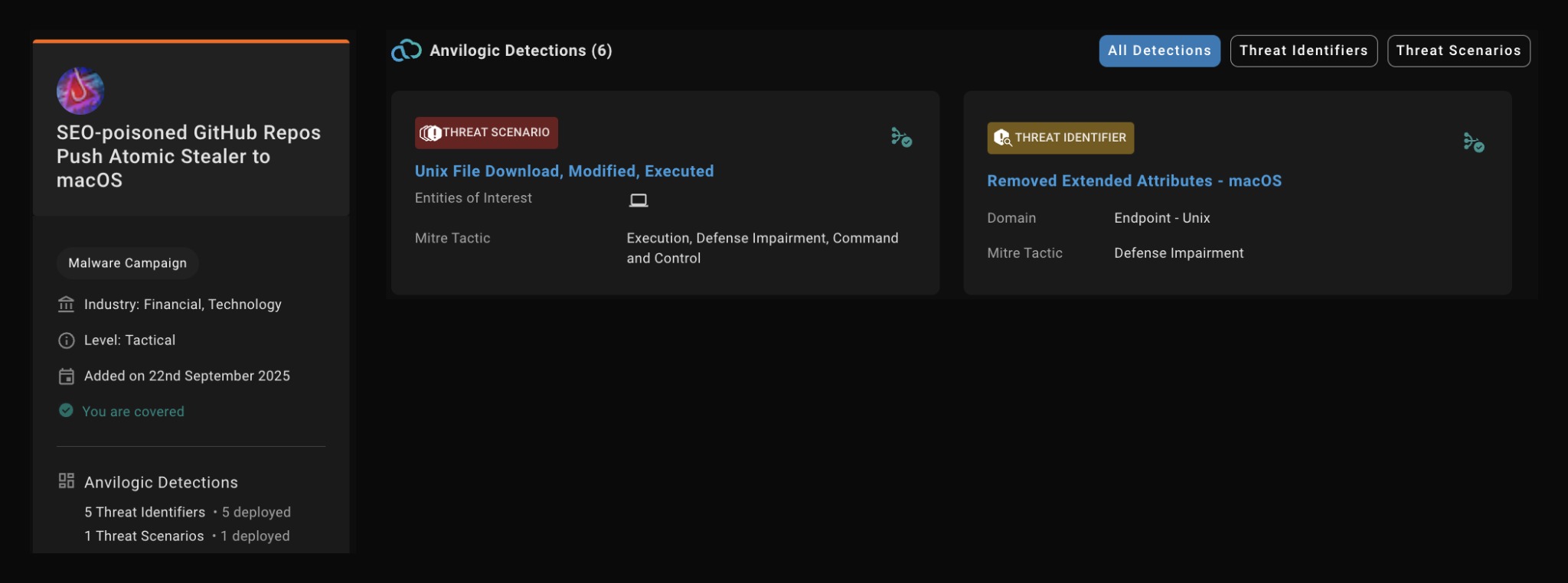
Anvilogic product view showing a trending malware campaign resolved to the Anvilogic threat identifiers and threat scenarios that address it, with deployed counts and a you are covered status
A trending topic resolves to the Anvilogic detections that address it and what this tenant actually has deployed, so “are we covered” is answered in one view instead of hours of manual checking.

The same principle applies during triage. One customer of Anvilogic’s runs under two-minute time-to-triage across 212 million events per month, and that isn’t a matter of adding another agent. It’s possible because the context is already connected when the alert arrives.

Why this is hard to copy

Several vendors will describe something like this over the next year, but three things differentiate Anvilogic’s Enterprise Security Graph from a memory feature.

  1. It has to span the stack, not one store. Any platform can build context over its own data store, but that context stops at the edge of the store. Most enterprise SOCs run detection and investigation across several platforms at once, which means context confined to a single lake or SIEM leaves most of the environment out. Anvilogic’s Enterprise Security Graph spans every connected repository without moving the data.
  2. It has to cover the whole lifecycle, not the alert queue. Point tools that triage alerts are reasoning over signals they didn’t generate. They don’t own the detection that fired, the tuning applied to it, or the onboarding decision that made the data available in the first place. If a source was never onboarded, the detection never fires, and the point tool never gets the chance to reason about it.
  3. It has to be governed, cited, and point-in-time. Session memory inside one agent’s workflow isn’t the same thing as a tenant-wide context layer with provenance on every fact, attribution on every decision, and approval gates on every write. The first is a convenience, and the second is something a security team can put in front of an auditor.

A top-20 U.S. mortgage lender evaluated Anvilogic against three alternatives and chose it on exactly this basis: breadth across the lifecycle, and AI that runs natively on the same platform that onboarded the data and deployed the detection.

Your SOC isn’t generic. Your AI shouldn’t be either.

The next phase of Agentic SecOps won’t be defined by who ships the most agents. It’ll be defined by who gives those agents enough context to make decisions that hold up in a specific environment. That takes more than a model, a prompt, and a set of integrations. It takes an operational memory of the SOC: the data, detections, alerts, workflows, decisions, outcomes, and relationships that explain how the organization actually works.

That’s what the Anvilogic Enterprise Security Graph provides. When an Anvilogic agent, Blueprint, or workflow begins a task, it doesn’t start from zero. It starts with your SOC.

Learn more about Anvilogic’s Enterprise Security Graph here, or talk to us to see it in action.

Get the Latest Resources

Leave Your Data Where You Want: Detect Across Snowflake

Demo Series
Leave Your Data Where You Want: Detect Across Snowflake
Watch

MonteAI: Your Detection Engineering & Threat Hunting Co-Pilot

Demo Series
MonteAI: Your Detection Engineering & Threat Hunting Co-Pilot
Watch
White Paper

AI Agents Need More Than Just Data, They Need the Context of Your SOC.

Agentic SecOps
September 29, 2026

AI Agents Need More Than Just Data, They Need the Context of Your SOC.

Agentic SecOps
No items found.

A generic AI agent starts every task from zero. It doesn’t know what data your organization has, where that data lives, which detections are deployed, what your team’s already tuned, how similar alerts were handled last quarter, or why an analyst made a particular call. You can give it a prompt and a set of integrations, but it’ll still begin each task by reconstructing context your platform already holds.

That’s a problem that’s especially acute in security operations because a SOC isn’t a collection of isolated tasks. Every decision depends on what came before it. An alert only means something when you understand the detection that produced it, the tuning applied to that detection, the quality of the feed underneath it, and what happened the last five times something similar fired.

Agents are getting easier to build, but giving them enough context to make decisions that actually reflect the environment they’re operating in is much harder. Anvilogic’s Enterprise Security Graph is built to solve that.

Your SOC already knows more than your AI does

Every day, security teams make thousands of decisions that shape how the SOC operates. A new feed gets onboarded, a detection gets deployed, an alert fires, an analyst determines it’s benign, a noisy condition gets allowlisted, or a case is closed as authorized activity. That history is the most accurate description of how your organization actually operates, but it’s scattered across product areas, workflows, and the heads of individual analysts. Even when the information exists, an agent starting a new task has to go find it again.

Anvilogic’s Enterprise Security Graph connects that accumulated operational history so agents and workflows begin with an understanding of the environment, its priorities, its history, and the reasoning behind past decisions.

Where the graph sits in Anvilogic’s AI Operating System

Anvilogic’s Agentic SecOps platform runs on four layers, and it’s worth understanding how they fit together, because the Enterprise Security Graph isn’t a standalone product. At the bottom is the Workflow Engine, the non-AI foundation that handles pipelines, integrations, and connectors, and it’s what actually moves and shapes the data. Above that are the AI agents, task-scoped workers that onboard a feed, write a search, build a detection, or triage an alert. Coordinating those agents is the AI Operating System, which decides which agent runs when, manages the context each one receives, and enforces the approval gates you’ve configured. And at the top are Blueprints, the orchestration layer that chains agents together into repeatable workflows your team can run the same way every time.

The Enterprise Security Graph is the context layer of that operating system. Agents are the workers and Blueprints are the workflows, but the graph is what either of them knows before they start. Without it, the AI OS can still route work to the right agent at the right time; it just routes an agent that’s starting from zero. With it, every agent and every Blueprint step runs on top of the same understanding of your environment, your priorities, your history, and your prior decisions, and everything they produce flows back into it.

Diagram of the Anvilogic AI Operating System layers, with Blueprints, agents, skills, connectors and tools in the analyst experience and the Enterprise Security Graph and context and memory under the hood
The Enterprise Security Graph is the context layer of the AI Operating System, so every agent and every Blueprint step runs on the same understanding of the environment, and everything they produce flows back into it.

Context isn’t more data, it’s the connections

Giving an agent access to more records doesn’t make it smarter. What matters is how those records relate to one another. Take a single alert. To investigate it well, an agent needs to know which detection generated it and which data feed that detection depends on. It needs to know whether the feed is healthy and trustworthy, what tuning has already been applied and why, how previous alerts from the same detection were resolved, and whether the same user, host, or indicator appeared in another case. That’s not one lookup. It’s a connected chain.

As a single thought, that chain might look like this: this alert came from this detection, which reads this feed, which carries a poor quality label and an open health failure, and the same host appeared in a case two weeks ago. No single product area holds that sentence, but the Enterprise Security Graph does, because Anvilogic links feeds to schemas, detections to the data they read, alerts to the detections that generated them, tuning decisions to their reasons, and cases to the entities, indicators, and outcomes involved.

Diagram of a single alert traversing the Enterprise Security Graph across detection lineage, feed trust, tuning history, verdict precedent, entity history and case precedent into a cited context pack
Before an agent starts, the Enterprise Security Graph pulls the detection lineage, feed trust, tuning history, verdict precedent, entity history, and case precedent behind a single alert.

The decisions matter as much as the alerts

Most security systems are good at recording what happened: a detection fired, an alert was created, a rule changed, or a case was closed. The more useful context, usually, is why. Why was this alert closed as benign? Why was this user allowlisted? Why did an analyst decline a tuning recommendation? Why was one event escalated, while an almost identical one wasn’t?

Those decisions encode the judgment of your SOC, which is why the Enterprise Security Graph treats them as content rather than exhaust. Verdicts, tuning accept and decline records, allowlist reasons, case closure codes, and Blueprint session justifications retain their full rationale, who made the decision, whether it was a human or an agent, and when it happened. Over time, agents can operate with precedent. Instead of only asking, “What does this alert look like?” they can also ask, “How has this organization handled situations like this before?”

Diagram of a tuning insight that is accepted or declined, each outcome carrying its reason and author, and both becoming the tuning standard for the team
Every tuning decision carries its reason and its author, so accepts and declines both become precedent for how this team tunes.

Context should improve every time the SOC works

The Enterprise Security Graph brings together context from across the full security operations lifecycle, not just the alert queue, so onboarding knows what feeds exist and what fields they expose, search knows where to look before it queries, detection connects threat priorities to deployed coverage and known gaps, and investigation receives an alert with its story already assembled.

It isn’t static, either; every workflow adds to it. When a Blueprint investigates an email alert, it records the steps it took, the evidence it used, the decisions it made, and the outcome. The next time a similar alert appears, that run is available as precedent, and after a hundred of them the system has a detailed picture of how this organization treats that specific kind of activity, without anyone having to write documentation. The hundredth email alert investigation gets measurably sharper than the first without anyone editing the instructions.

Memory in security has to be governed, and that’s a feature

Persistent AI context introduces real risk. An outdated allowlist shouldn’t influence a current investigation forever. A one-off exception shouldn’t become standard operating procedure, and an automated verdict shouldn’t carry the same weight as a decision approved by a senior analyst. The Enterprise Security Graph is built around those constraints rather than treating them as an afterthought.

Every fact traces back to the platform object it came from, and every context pack an agent receives cites clickable source objects that a human can verify. Human and agent actions are recorded and always distinguishable, permissions carry over exactly as they are in the platform, and when an agent writes something back, whether it’s a verdict, a tuning proposal, or a new detection draft, it goes through the approval gates the customer already configured. The graph also answers what was true at the time an alert fired, not just what’s true now, because detections get rewritten and feeds degrade, and that’s what makes precedent trustworthy instead of misleading. That combination is also the practical answer to the hallucination objection. An agent that has to cite its source object for every claim is an agent a security team can actually audit.

What this looks like in practice

A CISO sees a threat in the news and asks a simple question: are we covered? Answering that manually can take hours. Which techniques does the threat use? Which detections address them? Which of those detections are deployed here, and in what mode? Do we have the required data feeds? Where are the gaps, and what would it take to close them?

With the Enterprise Security Graph, that’s one traversal. The trending topic connects to the Armory detection content that addresses the threat, that content connects to this tenant’s deployed versions, and the gaps connect to the data categories and feeds required to close them, cross-checked against the threat priorities the org has already stated.

Anvilogic product view showing a trending malware campaign resolved to the Anvilogic threat identifiers and threat scenarios that address it, with deployed counts and a you are covered status
A trending topic resolves to the Anvilogic detections that address it and what this tenant actually has deployed, so “are we covered” is answered in one view instead of hours of manual checking.

The same principle applies during triage. One customer of Anvilogic’s runs under two-minute time-to-triage across 212 million events per month, and that isn’t a matter of adding another agent. It’s possible because the context is already connected when the alert arrives.

Why this is hard to copy

Several vendors will describe something like this over the next year, but three things differentiate Anvilogic’s Enterprise Security Graph from a memory feature.

  1. It has to span the stack, not one store. Any platform can build context over its own data store, but that context stops at the edge of the store. Most enterprise SOCs run detection and investigation across several platforms at once, which means context confined to a single lake or SIEM leaves most of the environment out. Anvilogic’s Enterprise Security Graph spans every connected repository without moving the data.
  2. It has to cover the whole lifecycle, not the alert queue. Point tools that triage alerts are reasoning over signals they didn’t generate. They don’t own the detection that fired, the tuning applied to it, or the onboarding decision that made the data available in the first place. If a source was never onboarded, the detection never fires, and the point tool never gets the chance to reason about it.
  3. It has to be governed, cited, and point-in-time. Session memory inside one agent’s workflow isn’t the same thing as a tenant-wide context layer with provenance on every fact, attribution on every decision, and approval gates on every write. The first is a convenience, and the second is something a security team can put in front of an auditor.

A top-20 U.S. mortgage lender evaluated Anvilogic against three alternatives and chose it on exactly this basis: breadth across the lifecycle, and AI that runs natively on the same platform that onboarded the data and deployed the detection.

Your SOC isn’t generic. Your AI shouldn’t be either.

The next phase of Agentic SecOps won’t be defined by who ships the most agents. It’ll be defined by who gives those agents enough context to make decisions that hold up in a specific environment. That takes more than a model, a prompt, and a set of integrations. It takes an operational memory of the SOC: the data, detections, alerts, workflows, decisions, outcomes, and relationships that explain how the organization actually works.

That’s what the Anvilogic Enterprise Security Graph provides. When an Anvilogic agent, Blueprint, or workflow begins a task, it doesn’t start from zero. It starts with your SOC.

Learn more about Anvilogic’s Enterprise Security Graph here, or talk to us to see it in action.

Resources

No items found.

See what Anvilogic can do for your SOC.

Talk to a practitioner who has been on your side of the problem.

September 29, 2026

AI Agents Need More Than Just Data, They Need the Context of Your SOC.

Agentic SecOps

Resources

No items found.

See what Anvilogic can do for your SOC.

Talk to a practitioner who has been on your side of the problem.

Product Vision
|
September 29, 2026
|
4 min read

AI Agents Need More Than Just Data, They Need the Context of Your SOC.

This is some text inside of a div block.

| Author

Agents are getting easier to build. Giving them enough context to make decisions that hold up in a specific environment is the hard part. Here is how Anvilogic's Enterprise Security Graph connects the SOC's accumulated operational history so every agent and Blueprint starts with it.

A generic AI agent starts every task from zero. It doesn’t know what data your organization has, where that data lives, which detections are deployed, what your team’s already tuned, how similar alerts were handled last quarter, or why an analyst made a particular call. You can give it a prompt and a set of integrations, but it’ll still begin each task by reconstructing context your platform already holds.

That’s a problem that’s especially acute in security operations because a SOC isn’t a collection of isolated tasks. Every decision depends on what came before it. An alert only means something when you understand the detection that produced it, the tuning applied to that detection, the quality of the feed underneath it, and what happened the last five times something similar fired.

Agents are getting easier to build, but giving them enough context to make decisions that actually reflect the environment they’re operating in is much harder. Anvilogic’s Enterprise Security Graph is built to solve that.

Your SOC already knows more than your AI does

Every day, security teams make thousands of decisions that shape how the SOC operates. A new feed gets onboarded, a detection gets deployed, an alert fires, an analyst determines it’s benign, a noisy condition gets allowlisted, or a case is closed as authorized activity. That history is the most accurate description of how your organization actually operates, but it’s scattered across product areas, workflows, and the heads of individual analysts. Even when the information exists, an agent starting a new task has to go find it again.

Anvilogic’s Enterprise Security Graph connects that accumulated operational history so agents and workflows begin with an understanding of the environment, its priorities, its history, and the reasoning behind past decisions.

Where the graph sits in Anvilogic’s AI Operating System

Anvilogic’s Agentic SecOps platform runs on four layers, and it’s worth understanding how they fit together, because the Enterprise Security Graph isn’t a standalone product. At the bottom is the Workflow Engine, the non-AI foundation that handles pipelines, integrations, and connectors, and it’s what actually moves and shapes the data. Above that are the AI agents, task-scoped workers that onboard a feed, write a search, build a detection, or triage an alert. Coordinating those agents is the AI Operating System, which decides which agent runs when, manages the context each one receives, and enforces the approval gates you’ve configured. And at the top are Blueprints, the orchestration layer that chains agents together into repeatable workflows your team can run the same way every time.

The Enterprise Security Graph is the context layer of that operating system. Agents are the workers and Blueprints are the workflows, but the graph is what either of them knows before they start. Without it, the AI OS can still route work to the right agent at the right time; it just routes an agent that’s starting from zero. With it, every agent and every Blueprint step runs on top of the same understanding of your environment, your priorities, your history, and your prior decisions, and everything they produce flows back into it.

Diagram of the Anvilogic AI Operating System layers, with Blueprints, agents, skills, connectors and tools in the analyst experience and the Enterprise Security Graph and context and memory under the hood
The Enterprise Security Graph is the context layer of the AI Operating System, so every agent and every Blueprint step runs on the same understanding of the environment, and everything they produce flows back into it.

Context isn’t more data, it’s the connections

Giving an agent access to more records doesn’t make it smarter. What matters is how those records relate to one another. Take a single alert. To investigate it well, an agent needs to know which detection generated it and which data feed that detection depends on. It needs to know whether the feed is healthy and trustworthy, what tuning has already been applied and why, how previous alerts from the same detection were resolved, and whether the same user, host, or indicator appeared in another case. That’s not one lookup. It’s a connected chain.

As a single thought, that chain might look like this: this alert came from this detection, which reads this feed, which carries a poor quality label and an open health failure, and the same host appeared in a case two weeks ago. No single product area holds that sentence, but the Enterprise Security Graph does, because Anvilogic links feeds to schemas, detections to the data they read, alerts to the detections that generated them, tuning decisions to their reasons, and cases to the entities, indicators, and outcomes involved.

Diagram of a single alert traversing the Enterprise Security Graph across detection lineage, feed trust, tuning history, verdict precedent, entity history and case precedent into a cited context pack
Before an agent starts, the Enterprise Security Graph pulls the detection lineage, feed trust, tuning history, verdict precedent, entity history, and case precedent behind a single alert.

The decisions matter as much as the alerts

Most security systems are good at recording what happened: a detection fired, an alert was created, a rule changed, or a case was closed. The more useful context, usually, is why. Why was this alert closed as benign? Why was this user allowlisted? Why did an analyst decline a tuning recommendation? Why was one event escalated, while an almost identical one wasn’t?

Those decisions encode the judgment of your SOC, which is why the Enterprise Security Graph treats them as content rather than exhaust. Verdicts, tuning accept and decline records, allowlist reasons, case closure codes, and Blueprint session justifications retain their full rationale, who made the decision, whether it was a human or an agent, and when it happened. Over time, agents can operate with precedent. Instead of only asking, “What does this alert look like?” they can also ask, “How has this organization handled situations like this before?”

Diagram of a tuning insight that is accepted or declined, each outcome carrying its reason and author, and both becoming the tuning standard for the team
Every tuning decision carries its reason and its author, so accepts and declines both become precedent for how this team tunes.

Context should improve every time the SOC works

The Enterprise Security Graph brings together context from across the full security operations lifecycle, not just the alert queue, so onboarding knows what feeds exist and what fields they expose, search knows where to look before it queries, detection connects threat priorities to deployed coverage and known gaps, and investigation receives an alert with its story already assembled.

It isn’t static, either; every workflow adds to it. When a Blueprint investigates an email alert, it records the steps it took, the evidence it used, the decisions it made, and the outcome. The next time a similar alert appears, that run is available as precedent, and after a hundred of them the system has a detailed picture of how this organization treats that specific kind of activity, without anyone having to write documentation. The hundredth email alert investigation gets measurably sharper than the first without anyone editing the instructions.

Memory in security has to be governed, and that’s a feature

Persistent AI context introduces real risk. An outdated allowlist shouldn’t influence a current investigation forever. A one-off exception shouldn’t become standard operating procedure, and an automated verdict shouldn’t carry the same weight as a decision approved by a senior analyst. The Enterprise Security Graph is built around those constraints rather than treating them as an afterthought.

Every fact traces back to the platform object it came from, and every context pack an agent receives cites clickable source objects that a human can verify. Human and agent actions are recorded and always distinguishable, permissions carry over exactly as they are in the platform, and when an agent writes something back, whether it’s a verdict, a tuning proposal, or a new detection draft, it goes through the approval gates the customer already configured. The graph also answers what was true at the time an alert fired, not just what’s true now, because detections get rewritten and feeds degrade, and that’s what makes precedent trustworthy instead of misleading. That combination is also the practical answer to the hallucination objection. An agent that has to cite its source object for every claim is an agent a security team can actually audit.

What this looks like in practice

A CISO sees a threat in the news and asks a simple question: are we covered? Answering that manually can take hours. Which techniques does the threat use? Which detections address them? Which of those detections are deployed here, and in what mode? Do we have the required data feeds? Where are the gaps, and what would it take to close them?

With the Enterprise Security Graph, that’s one traversal. The trending topic connects to the Armory detection content that addresses the threat, that content connects to this tenant’s deployed versions, and the gaps connect to the data categories and feeds required to close them, cross-checked against the threat priorities the org has already stated.

Anvilogic product view showing a trending malware campaign resolved to the Anvilogic threat identifiers and threat scenarios that address it, with deployed counts and a you are covered status
A trending topic resolves to the Anvilogic detections that address it and what this tenant actually has deployed, so “are we covered” is answered in one view instead of hours of manual checking.

The same principle applies during triage. One customer of Anvilogic’s runs under two-minute time-to-triage across 212 million events per month, and that isn’t a matter of adding another agent. It’s possible because the context is already connected when the alert arrives.

Why this is hard to copy

Several vendors will describe something like this over the next year, but three things differentiate Anvilogic’s Enterprise Security Graph from a memory feature.

  1. It has to span the stack, not one store. Any platform can build context over its own data store, but that context stops at the edge of the store. Most enterprise SOCs run detection and investigation across several platforms at once, which means context confined to a single lake or SIEM leaves most of the environment out. Anvilogic’s Enterprise Security Graph spans every connected repository without moving the data.
  2. It has to cover the whole lifecycle, not the alert queue. Point tools that triage alerts are reasoning over signals they didn’t generate. They don’t own the detection that fired, the tuning applied to it, or the onboarding decision that made the data available in the first place. If a source was never onboarded, the detection never fires, and the point tool never gets the chance to reason about it.
  3. It has to be governed, cited, and point-in-time. Session memory inside one agent’s workflow isn’t the same thing as a tenant-wide context layer with provenance on every fact, attribution on every decision, and approval gates on every write. The first is a convenience, and the second is something a security team can put in front of an auditor.

A top-20 U.S. mortgage lender evaluated Anvilogic against three alternatives and chose it on exactly this basis: breadth across the lifecycle, and AI that runs natively on the same platform that onboarded the data and deployed the detection.

Your SOC isn’t generic. Your AI shouldn’t be either.

The next phase of Agentic SecOps won’t be defined by who ships the most agents. It’ll be defined by who gives those agents enough context to make decisions that hold up in a specific environment. That takes more than a model, a prompt, and a set of integrations. It takes an operational memory of the SOC: the data, detections, alerts, workflows, decisions, outcomes, and relationships that explain how the organization actually works.

That’s what the Anvilogic Enterprise Security Graph provides. When an Anvilogic agent, Blueprint, or workflow begins a task, it doesn’t start from zero. It starts with your SOC.

Learn more about Anvilogic’s Enterprise Security Graph here, or talk to us to see it in action.

Resources

No items found.