
.svg)


Part one of our Agentic SecOps blog series ended with an uncomfortable conclusion: the thing that doesn't scale in a SOC isn't headcount, it's judgment. Your best analyst's instinct for what's worth chasing lives in one head and is available one shift at a time. You can't hire your way around that, and a decade of security tooling hasn't automated it.
Agentic SecOps is the answer taking shape, and it's worth being precise about what it means, because the term is already being stretched to cover anything with "AI" on the datasheet.
Here's the plain version: Agentic SecOps is a model for security operations where AI agents do the everyday work of the SOC (onboarding data, searching across it, building and tuning detections, and investigating alerts) running on the data and tools a team already has, with humans approving the decisions that carry real weight.
Two words in the name are doing the work. Agentic means the AI acts, not just advises; it deploys the detections, runs the investigations, and closes or escalates the cases, instead of summarizing them and handing them back. SecOps means the full lifecycle, not just the alert queue, from onboarding a raw log source to closing an investigation, not just one slice in the middle.
If you're evaluating an AI SOC or AI triage product right now, that is one part of this picture (the alert-queue part), not the whole model.
The shift from assist to act
The idea isn't fringe, and the market is busy naming it. Gartner added AI SOC Agents to its Hype Cycle for Security Operations and moved them from the earliest stage to the peak of inflated expectations in a single year, which tells you how fast the category is forming and how much noise is attached to it now.
The useful part isn't the hype, it's the distinction Gartner draws underneath it: the line between an AI agent and an AI assistant. An assistant accelerates an analyst's keystrokes. It summarizes an alert, drafts a query, answers a question. An agent acts across the investigation on its own. Gartner's assessment is that most of what ships as "agentic" today is, by that definition, still an assistant.
That distinction is the whole point, and it's why Part 1's conclusion matters. An assistant makes a person faster at the work; an agent actually does the work. Only one of those changes the math when data is compounding and headcount is stagnant.
Gartner expects agentic AI to go from fewer than 5% of enterprises in 2025 to roughly 70% by 2029. The direction of security operations is set, but what's unsettled is how to get there responsibly, and the same analysts are blunt about the catch. Forrester says that governance gaps are already producing "agentic sprawl," and that returns stay stuck in pilots when teams can't trust what the agents do. So the real question was never whether AI can act, it's whether you can trust what it does when it acts, and we'll come back to that.

What AI agents actually do
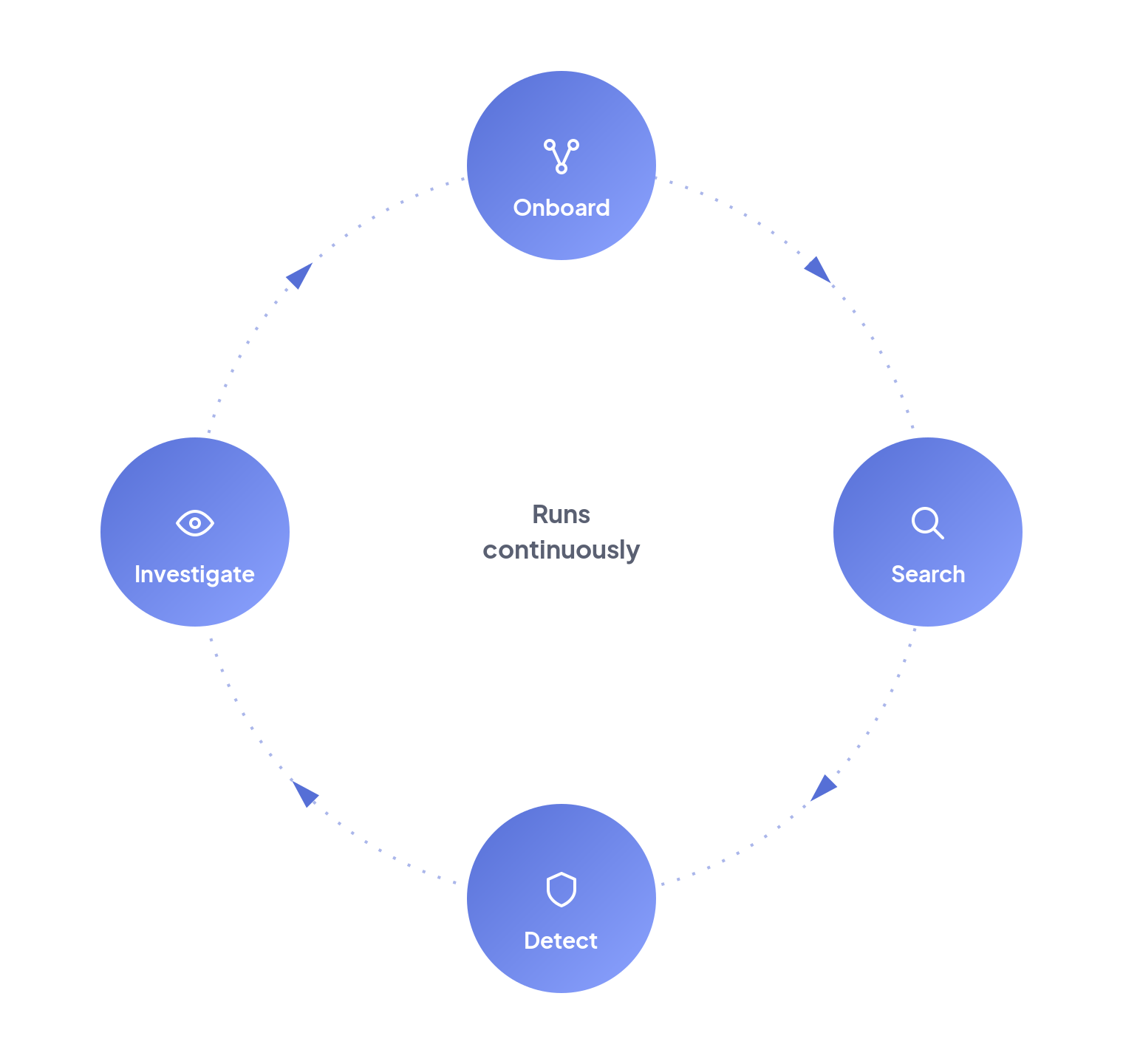
Strip away the abstraction, and the everyday work of a SOC is really four jobs, done over and over: getting data ready to use, searching across it, writing the detections that catch threats, and investigating what those detections surface. Agentic SecOps puts an agent on each of those jobs. Not a chatbot that helps a person do them faster, an agent that does the job and shows its work.
Onboard. A new log source usually means a data engineering project: parse the format, normalize the fields, map it to a schema. That's weeks of work before a single detection even runs on it. An onboarding agent does that in hours. Point it at a feed, and it profiles the data, proposes a parser and mapping, and makes the source detection-ready, so new data stops sitting in a backlog waiting for someone to find time.
Search. Security data lives in a dozen places, a SIEM, a data lake, cloud storage, an EDR console, each with its own query language. Answering one question means pivoting between tools and stitching the results together by hand. A search agent runs a single question, asked in plain language, across every connected platform at once, without moving the data, and returns one answer instead of four dashboards to reconcile.
Detect. Coverage gaps open faster than most teams can close them, because writing and tuning detections is slow, specialized work. A detection agent takes a threat, whether it's a new intel report or a gap a simulation exposed, and turns it into a validated, deployed detection across the platforms a team runs, then keeps tuning it to hold down false positives instead of letting them accumulate.
Investigate. This is where the pain is loudest. Most SOCs field more alerts than they can work, and as Part 1 covered, close to half are false positives, and most are never actioned at all. An investigation agent triages the alert, gathers the context, scores the severity, and hands the analyst a decided case with the reasoning attached, instead of a raw queue to wade through. Triage stops depending on who happens to be on shift.
Four jobs, four agents, running on the data and tools a team already has. Onboarding feeds search, search feeds detection, detection feeds investigation, and the loop runs continuously instead of in whatever gaps the team can find.
Where other tools stop
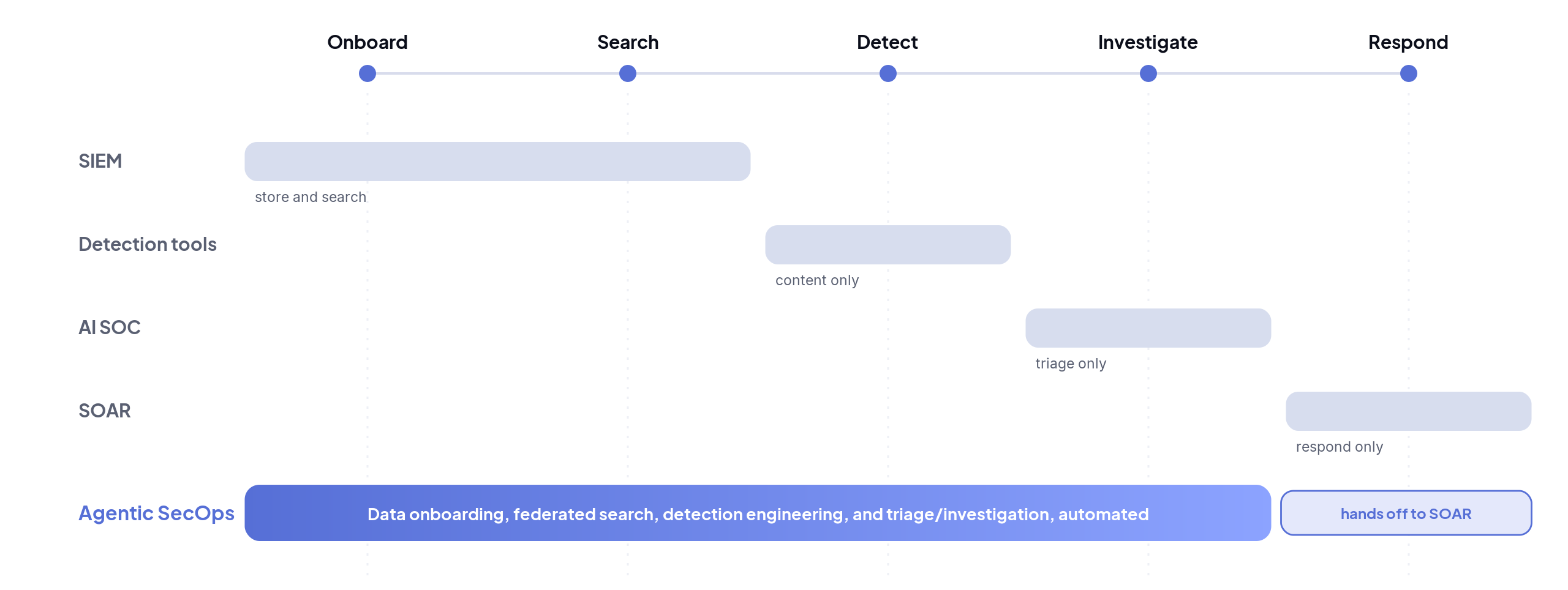
Agentic SecOps is easiest to place by looking at what came before it, because each earlier category solved one slice of the problem and stopped at the edge of it. Agentic SecOps picks up where they stop, and when a team needs it to, does their job too.
SIEMs centralize data and let you search and alert on what you've ingested. They're the system of record, and they're good at that. Where they stop is the data you couldn't afford to ingest, and the work beyond the query. Their cost curve also bends the wrong way. The bill increases with every gigabyte, which is why teams end up dropping the data they can least afford to lose. They store and surface, but they don't write the detections, run the investigation, or reach the logs left in a data lake or cloud storage. Agentic SecOps runs detection and investigation on your data wherever it lives, with no forced migration. For a team standing up a data lake or moving off a SIEM, it can serve as the detection and investigation layer itself; for a team keeping its SIEM, it runs alongside. Either way, nothing is ripped out.
Detection tools ship libraries of prebuilt detections and help manage rules across environments, which gives teams a head start on coverage. Where they stop is the content itself. They hand you rules, but they don't onboard the data those rules run on, search across it, or investigate what fires, and the detections still need someone to tune them. Agentic SecOps treats detection engineering as one job inside the lifecycle. It builds, deploys, and continuously tunes detections against your own data, then carries that same context straight into the investigation, instead of stopping at a catalog of content.
SOARs automate the response after a decision has already been made. Give them a playbook, and they'll open the ticket, block the IP, and notify the channel the same way every time. Where they stop is judgment: a playbook runs the steps it was handed and can't adapt when the situation doesn't match. Agentic SecOps sits a layer up. It makes the call an analyst would make, then hands execution to the SOAR a team already runs, or takes the action itself through a connector when that's what the team wants. The decision is the hard part, and that's the part it owns.
AI SOC tools reason over the alert queue. They summarize alerts and suggest next steps, which helps, but they work over alerts they don't own, with context they weren't built with, and they stop at triage. If a detection never fired because a source was never onboarded, the tool never sees the threat at all. Agentic SecOps runs the whole lifecycle, so triage and investigation happen on the same platform that onboarded the data and wrote the detection. The context isn't borrowed, it's built in.
Read down that list, and the pattern repeats. The older tools each automate or accelerate one step, but Agentic SecOps automates the work end to end. It scales the judgment of your team across data that's scattered by design, without scaling headcount to match. It also bends the cost curve, because the value comes from running on the data where it already lives instead of paying to centralize all of it. And it flexes to whatever a team already runs, so it can stand alone on a data lake, alongside an existing SIEM and SOAR, or stand in for them when a team doesn't have either. Nothing has to be ripped out to start.
None of this means handing the SOC to a machine. Agents act, but the model is built around human approval at the points that carry weight. A new detection is reviewed before it goes live. Disabling an account or isolating a production server waits for a person to sign off. Everywhere else, the agents execute and record their reasoning, so the team approves decisions instead of doing the legwork. Automation you can't inspect isn't automation; it's a black box, and that's the opposite of the point.
What changes for the SOC
The problem was never a shortage of people, it's that the judgment that makes a SOC effective doesn't scale, because it lives in a few heads and is available a few shifts a day. Every tool built to help has either moved the data, sped up a person, or scripted a fixed response. None of them closed the gap, because none of them did the work.
Agentic SecOps closes it by doing the work. Data gets onboarded in hours instead of waiting in a backlog. One question runs across every platform at once instead of one console at a time. Detections get written and tuned continuously instead of in the gaps between fires. Alerts arrive as decided cases instead of a queue nobody has time for. The work that used to depend on who was on shift can now run in the background, and the people are freed for the part that actually needs a human, like the hard investigations, the judgment calls, and the decisions worth signing off on.
That's the shift. Not a faster SOC doing the same manual work, but a SOC where the everyday work runs itself and the team spends its time where it counts. The next question is what that work runs on, because an agent is only as good as the data it can reach. That's where we go next in part 3 of our Agentic SecOps series: why buying more data has actually made visibility worse, and what it takes to search across everything a team already has.