
.svg)


Part three ended on the question that stalls most agentic SOC projects before they get anywhere. Once an agent can see across the whole environment and act on what it finds, every security leader runs into the same worry before they'll let it near production, which is whether the thing can be trusted. It's a fair worry, and most of the AI being sold to SOCs today can't really answer it. The problem isn't that the technology is bad, it's that these tools are built in a way that makes trust very hard to establish in the first place.
Trust isn't a feature you turn on
The pitch for autonomous security AI usually arrives as a switch. Flip it, and the AI works your alerts on its own. The problem is that no SOC leader thinks about trust that way, and none should. You don't hand an unfamiliar analyst the keys to production on day one either. You watch their work, you check their reasoning, you give them more rope as they earn it. Trust is a gradient, built case by case. A tool that offers only two settings, off or fully autonomous, has misread the thing it's asking for. So, the real question isn't if you trust the AI, it's if it can show you its work and can control where it acts, while you decide the things that matter. Most AI for the SOC answers no to both for three structural reasons.
Why most AI for the SOC can't be trusted to act
- It reasons over data it doesn't own. The current wave of AI SOC tools sits on top of the alert queue and reasons about alerts produced somewhere else. It didn't onboard the data source or write or deploy the detection that fired. So, when it reaches for context, it works with whatever it was handed, and it has no way to go get the log it's missing. An analyst who inherits a case with half the file has the same problem, and we don't call that trustworthy; we call it a starting point.
- The verdict is a black box. Most of these tools return an answer without the work behind it (e.g., "malicious, 87 percent confidence.") An analyst who can't see how the verdict was reached has two options: take it on faith or redo the investigation to check it, and the second one erases the time the tool was supposed to save. A verdict you have to re-derive is not a verdict, it's a suggestion with a number attached.
- It's all or nothing. Because the reasoning is hidden, there's nowhere natural to put a human. The tool advises and a person does the work anyway, or the tool runs on its own, and the person finds out after. There's no gradient in between, no way to automate the routine 90%, while holding the line on decisions that carry real risk. That missing middle is exactly where a real SOC operates.
What it takes to trust an agent that acts
Trust in an agent is built the same way trust in a person is. You can see how it thinks, control what it's allowed to do, and it works from the full picture instead of a borrowed one. Three things have to be true:
- Show the work, every time. Every Anvilogic verdict carries its reasoning, the steps taken, the data pulled, and the logic that led to the call, laid out so an analyst can check it in seconds instead of rebuilding it. You extend rope to an agent whose reasoning you can read, not one whose confidence score you have to accept.
- You decide where it acts. Approval gates aren't a limitation, they're how the platform is built. You set which actions run on their own and which stop for a person, and the AI Operating System holds those gates on every run. When you first switch on a Blueprint, you keep a person in front of every step that carries real consequences, so nothing happens without someone signing off on it. Then, as you watch a particular type of alert get handled correctly over and over, you let that step start running on its own, at whatever pace your team is comfortable with, rather than one the vendor sets. Early on, the analyst approves the agent's work; later they're supervising it and stepping in only when something looks off.
- Run natively, not on borrowed context. This is the part a triage-only tool can't copy. Anvilogic triages and investigates on the same platform that onboarded the data and deployed the detection. The agent working an alert can reach the source that generated it (and every other source), because search runs in place across the whole environment. It's not reasoning about someone else's output, it's working the case with the full record in front of it. An agent you can trust to act is one that can actually see everything before it acts.
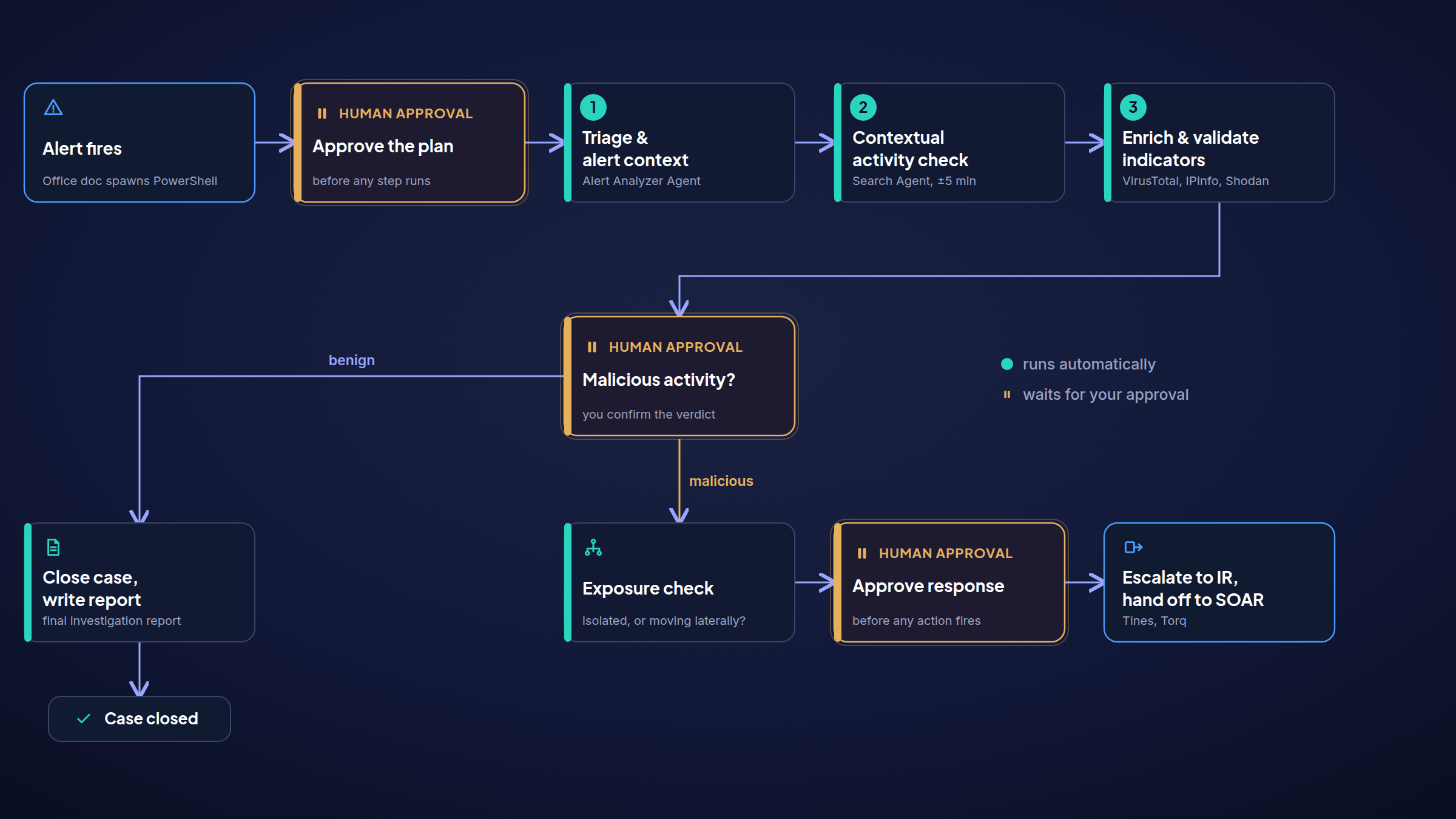
The analyst moves above the loop
Put those three together, and the fear that drives the autonomous SOC pitch starts to fade. Nobody is removed from the loop, people just move above it, directing agents that work at machine scale and keeping the judgment that carries risk in human hands. The routine clearing that used to eat a shift runs on its own, under reasoning the analyst can audit and gates the analyst set. The hard calls still belong to people who now reach them with a decided case instead of a blank one.
The bigger picture
It's worth stepping back across the whole series, because the four posts really add up to a single argument: the SOC's problem was never a shortage of tools or a shortage of data; it was that the work stopped scaling through people, even as the volume of data and alerts kept climbing. The first post put a number on the SIEM cost curve and showed why the old instinct to centralize everything eventually became impossible to afford. The second laid out the alternative, a set of agents that carry out the four jobs of the SOC (onboarding, search, detection, and investigation), instead of producing one more dashboard for a person to read. The third explained why none of that holds up until those agents can see across all of the data, wherever a team keeps it. Trust is the last of those gates, and it's the one that decides whether any of the rest ever reaches production. It begins to open when the agent can show its work, when it acts only in the places you've allowed, and when it reasons from the full picture instead of a borrowed slice of it.
That's what Agentic SecOps means once you get past the label. It isn't an AI that pushes the analyst out of the job, and it isn't one you're asked to take on faith. It's a way to run security operations at a scale no team could reach on its own, on the stack you already have, with your people in control of every decision that carries real weight.
If you want to see what Anvilogic Agentic SecOps looks like, watch our Blueprints demos here:
- Demo 1: onboard data for data lakes
- Demo 2: detection engineering validation
- Demo 3: automate investigations
To learn more about Blueprints or get a demo from our team, contact us.